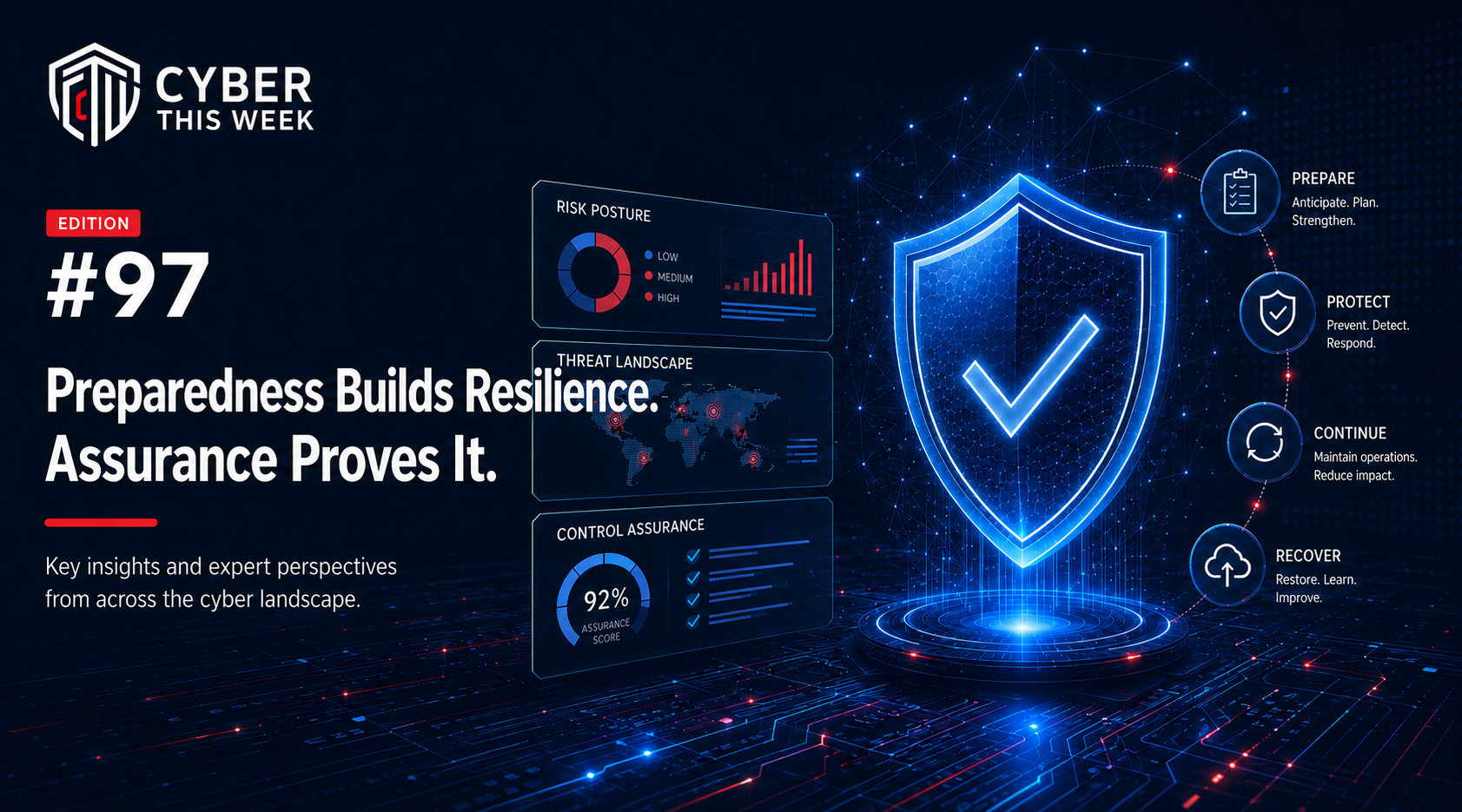
Preparedness Builds Resilience. Assurance Proves It.
Cyber This Week Edition 97 explores AI-speed cyber risk, disaster recovery, security assurance, OT zero trust, cyber insurance, SOC containment, vendor risk, critical infrastructure, and quantum readiness.
Cybersecurity is entering a phase where preparedness is becoming a stronger differentiator than prevention alone. This edition of Cyber This Week examines how AI is accelerating the pace of cyber risk while exposing gaps in organisational readiness, disaster recovery, and governance. As threat actors evolve and regulatory expectations rise, resilience is increasingly being measured by an organisation's ability to anticipate, adapt, and recover. From major cyberattacks and vendor-driven breaches to the growing importance of security assurance, quantum readiness, and board-level conversations around operational technology, the landscape is becoming more interconnected. The challenge is no longer simply responding to threats. It is building confidence that systems, leadership, and processes can withstand them.
This Week's Articles
- 01Security Magazine
AI Is Outpacing Cyber Defense: Security Must Shift from Reaction to Readiness
This article argues that AI is advancing faster than conventional security models, making reactive defences insufficient. It stresses the need for proactive readiness, updated architectures, and security programmes designed for AI-speed threats.
Why it mattersSecurity teams cannot rely only on detecting and responding after an attack begins. AI-speed threats require preparation, adaptive controls, and faster decision-making.
- 02CRN
10 Major Cyberattacks and Data Breaches in 2026 (So Far)
A half-year review of significant breaches and attacks, this article highlights the scale and diversity of incidents across industries. It also suggests that AI-powered tactics are increasingly shaping modern threat activity.
Why it mattersReviewing major incidents helps organisations understand current attack patterns, affected sectors, and the growing role of AI in threat operations.
- 03CSO Online
What CISOs Need to Tell the Board About Zero Trust in OT: A 90-Day Communication and Action Plan
This article focuses on practical zero-trust adoption in operational technology environments, where ideal models often do not fit reality. It translates strategy into an achievable near-term action plan for critical-infrastructure leaders.
Why it mattersOT security requires realistic plans that account for uptime, legacy systems, operational safety, and board-level accountability.
- 04InformationWeek
AI Disaster Recovery Planning Is Years Behind AI Adoption
The article highlights a growing resilience gap between rapid AI deployment and lagging recovery planning. Organisations are increasingly relying on AI without equally modern backup, continuity, and recovery strategies.
Why it mattersAI adoption without recovery planning can create serious operational dependency. Organisations must prepare for AI-system failure, corruption, or prolonged disruption.
- 05Forbes Business Council
Security Assurance Is Now Proof of Cyber Maturity
This article explains that cybersecurity maturity is no longer demonstrated simply by having policies, controls, and tools in place. Organisations must provide measurable assurance that controls work effectively, risks are actively managed, and the business can withstand and recover from incidents.
Why it mattersCyber maturity must be demonstrated through evidence and outcomes. Boards, insurers, regulators, and customers increasingly expect proof that controls are effective.
- 06Cybersecurity Dive
As Cyber Risk Evolves, the Insurance Industry Tightens Guardrails
This article explains how cyber insurers are responding to worsening risk conditions by imposing stricter underwriting and coverage expectations. Insurance is becoming a stronger driver of security standards, claims discipline, and board-level risk management.
Why it mattersCyber insurance requirements increasingly influence security investment, governance, incident preparedness, and the evidence organisations must provide.
- 07SC World
Stay Ahead in the SOC: Contain Threats with Confidence and Control
The article addresses the challenge of containing AI-driven intrusions at machine speed without unnecessarily disrupting operations. It focuses on containment, precision response, and the practical limits of automation for security operations centre teams.
Why it mattersFast containment must still be controlled and accurate. Poorly designed automated responses can disrupt business operations or create additional risk.
- 08CXO Today
Powering Up: How the Energy Sector Is Scaling AI and Cyber Resilience in 2026
This article examines how the energy sector and related industries are accelerating AI adoption while strengthening governance and cyber resilience. It is strategically important for critical infrastructure, where digital transformation and threat exposure are rising together.
Why it mattersEnergy organisations must balance innovation with operational reliability, safety, governance, and resilience against cyber disruption.
- 09Dark Reading
Third-Party Breaches Teach the Education Sector a Costly Lesson in Vendor Risk
The article highlights how vendor and supply-chain weaknesses are creating serious exposure in education environments. Its central lesson is that third-party risk management is essential to protecting sensitive data and reducing ransomware impact.
Why it mattersOrganisations remain exposed through vendors even when their own internal controls are strong. Supplier visibility and accountability are essential.
- 10CPO Magazine
Products That Are Not "Quantum-Safe" May Soon Be Ineligible for Cybersecurity Certification in France
This article covers an emerging regulatory shift towards quantum-safe security requirements for cybersecurity certification in France. It is an important forward-looking policy signal, although its immediate operational impact is narrower than the other issues in this edition.
Why it mattersQuantum-readiness requirements may soon influence procurement, product design, certification, and long-term cryptographic planning.