
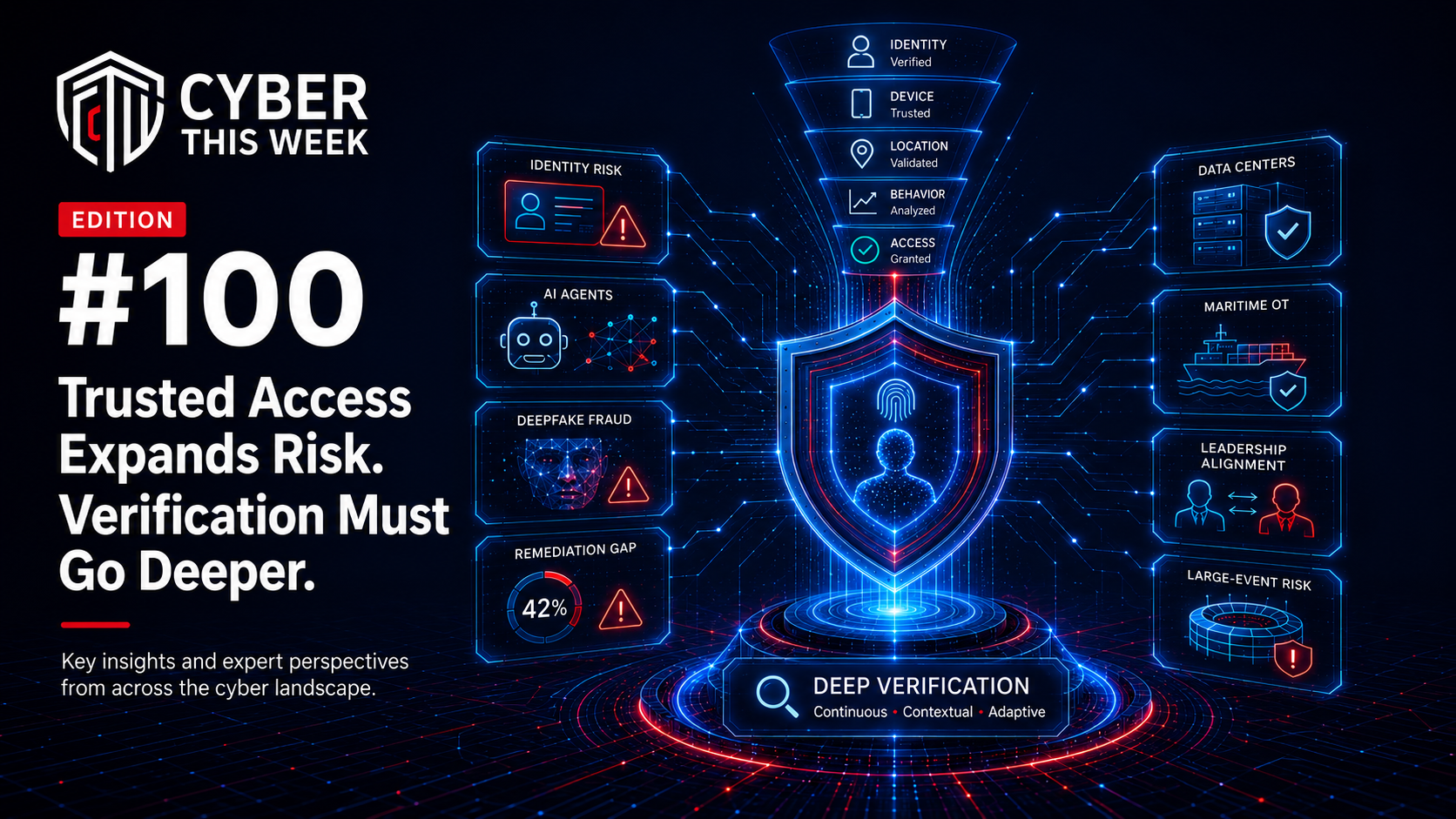
Trusted Access Expands Risk. Verification Must Go Deeper.
Cyber This Week Edition 100 explores identity-driven ransomware, AI-powered breaches, deepfake fraud, AI-agent access, Zero Trust, vulnerability remediation, data-centre security, maritime OT, leadership alignment, and ecosystem resilience.
Cybersecurity risk is shifting from unauthorised access to the misuse of legitimate access. This edition of Cyber This Week examines how identity attacks, AI-assisted breaches, deepfakes, autonomous agents, and known but unresolved vulnerabilities are exposing weaknesses in verification, remediation, and incident response. Across data centres, maritime systems, global events, and enterprise leadership, the message is consistent: resilience depends on more than tools. Organisations need stronger behavioural controls, faster response, better coordination, and risk models designed for interconnected environments. As attackers move faster and trusted systems become attack paths, security must focus on what access allows, how decisions are verified, and how quickly disruption can be contained.
This Week's Articles
- 01Dark Reading
Identity Attacks Overtake Exploits as Top Ransomware Cause
Email-driven identity attacks have surpassed vulnerability exploits as the leading cause of ransomware incidents, shifting attention toward credential misuse. Although MFA was present in 97% of credential-based attacks, weak implementations and attacker bypass techniques often rendered it ineffective. The article emphasises phishing-resistant MFA and stronger identity-security controls.
Why it mattersMFA presence alone does not guarantee identity security. Organisations need phishing-resistant authentication, stronger session protection, secure recovery processes, and continuous identity monitoring.
- 02CSO Online
AI-Powered Breaches Provide Wake-Up Call for Incident Response
Recent breaches show attackers using AI throughout the entire attack chain—not only to create phishing messages—resulting in faster and more adaptive operations. Security teams should update incident-response playbooks, detection logic, and threat-hunting practices to address AI-assisted campaigns with shorter dwell times.
Why it mattersAI can accelerate attacker decisions and movement. Incident-response teams need updated playbooks, faster detection, better automation, and regular exercises for AI-assisted attacks.
- 03SC World
What AI Fraud and Deepfake Failure Costs the Business
High-value activities such as wire transfers, payment-detail changes, credential resets, and data-access approvals often rely on a single voice, video, email, or chat message as proof of identity and authority. AI-generated fraud and deepfakes exploit this channel-based trust, highlighting the need for stronger, multistep authorisation and verification processes.
Why it mattersA convincing voice, video, or message is no longer reliable proof of authority. Sensitive business actions require independent verification, separation of duties, and multistep approval.
- 04Forbes Technology Council
When AI Agents Have Valid Access, Zero Trust Needs More Than Identity
Anthropic's “Zero Trust for AI Agents” framework recognises AI systems with legitimate access as first-class actors within trusted workflows. The article argues that Zero Trust must extend beyond identity to include behavioural restrictions, intent verification, and continuous authorisation governing what agents can do, which data they can access, and under what conditions.
Why it mattersA valid identity does not make every action safe. AI-agent security must evaluate intent, behaviour, permissions, data access, and context continuously.
- 05SecurityInfoWatch
AI Agents Are Expanding the Attack Surface. Here's How to Respond.
Autonomous AI agents are operating within enterprise workflows and using legitimate access to act on behalf of people, creating a new internal attack surface. The article recommends applying continuous verification, least privilege, and strong guardrails around tools and data to contain these risks without preventing innovation.
Why it mattersAutonomous agents can act at speed using legitimate permissions. Organisations need clear ownership, limited access, behavioural monitoring, auditability, and controls around tools and sensitive data.
- 06Help Net Security
Companies Keep Getting Breached by Vulnerabilities They Already Knew About
Modern scanning tools identify more vulnerabilities than ever, yet organisations continue to be compromised through weaknesses they had already discovered. Research from Vicarious indicates that the core problem is a remediation gap involving slow or unsuccessful assignment, approval, patch deployment, and validation—not a lack of vulnerability discovery.
Why it mattersFinding vulnerabilities does not reduce risk unless they are fixed and validated. Security and IT teams need stronger ownership, workflow tracking, prioritisation, and remediation accountability.
- 07A&O Shearman
Why Data Centers Are High-Value Targets for Cyber Attacks
As data centres become larger and more interconnected, they increasingly function as critical infrastructure and attractive cyberattack targets. The article emphasises facility-level cybersecurity controls, resilience planning, and regulatory oversight because an attack on one data centre can produce systemic consequences across multiple tenants.
Why it mattersA single data-centre incident can affect many organisations simultaneously. Operators and tenants need shared resilience planning, physical and cyber controls, clear responsibilities, and tested continuity arrangements.
- 08Security Magazine
You Can't Secure a Ship Like a Laptop
Ships operate as unattended edge environments with autonomous systems, intermittent connectivity, and limited onboard expertise for handling complex OT and ICS incidents. Treating vessels as ordinary remote offices is inadequate; maritime security requires remote integrity checks, strong network segmentation, and controls designed around operational safety.
Why it mattersMaritime environments combine cyber risk with physical safety and operational continuity. Security controls must reflect intermittent connectivity, limited local support, and specialised OT systems.
- 09CIO
The Last Human Relationship in Cybersecurity
Even advanced AI-driven security tools can fail when CIOs and CISOs lack trust or do not coordinate their strategies, budgets, and priorities. The article presents the CIO–CISO relationship as a critical organisational control for aligning technology, business objectives, and cyber risk.
Why it mattersTechnology and security decisions are deeply connected. Strong CIO–CISO trust improves priorities, investment choices, accountability, incident response, and organisational resilience.
- 10World Economic Forum
Three Lessons on Cybersecurity and Digital Risk From the World Cup
The World Cup operates as a temporary digital economy connecting stadiums, broadcasters, payment systems, transport networks, and millions of fans. With 84% of sports organisations reporting a cyber incident in the previous year, the article highlights lessons in ecosystem-wide risk management, cross-stakeholder coordination, and resilience planning for major high-availability events.
Why it mattersMajor events depend on many interconnected organisations and services. Resilience requires shared visibility, coordinated response, clear accountability, and preparation for cascading disruption.