
AI Accelerates Risk. Resilience Must Operate Continuously.
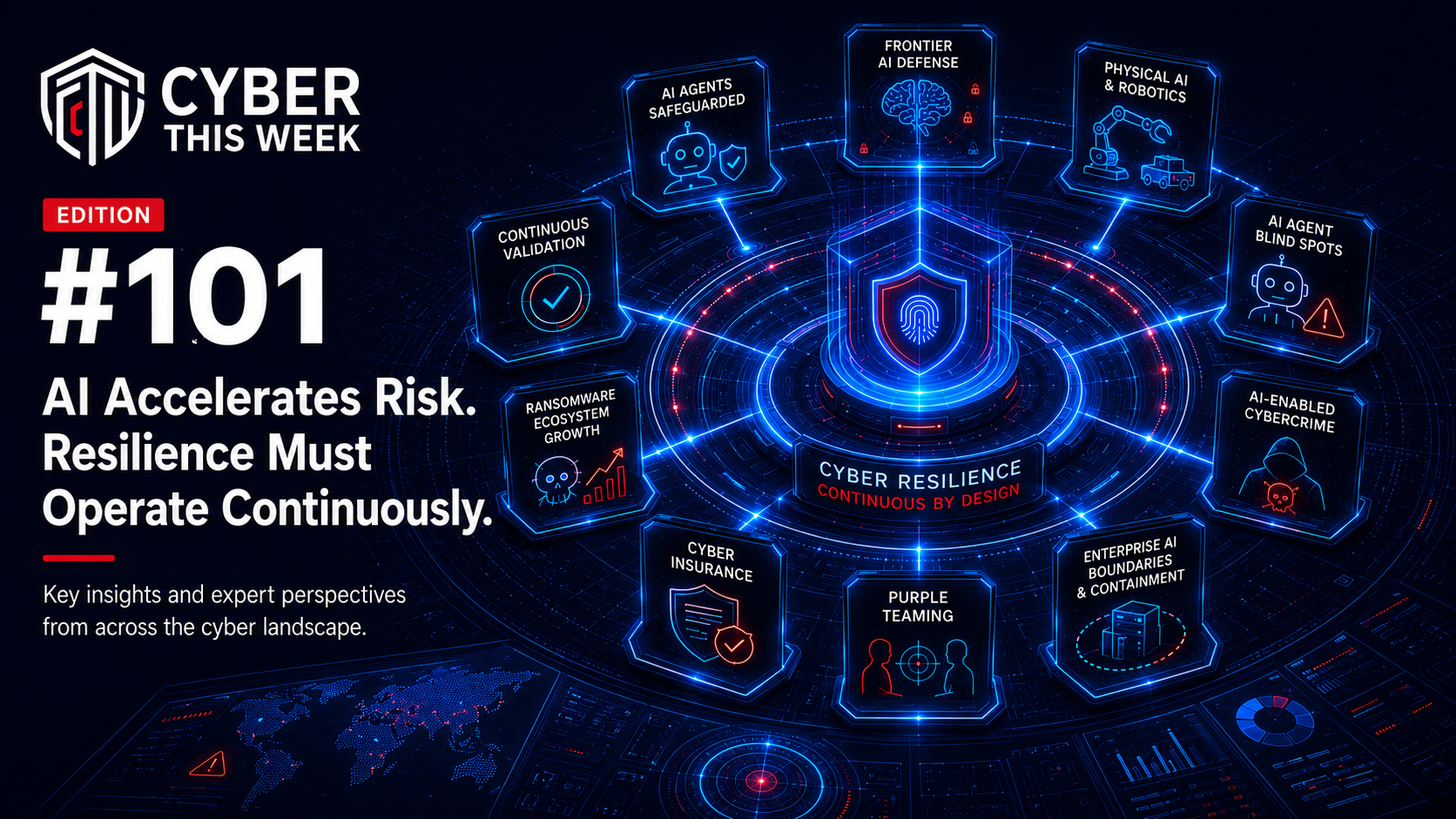
Cyber This Week Edition 101 explores continuous cyber resilience, frontier AI defence, physical AI, agent blind spots, AI-enabled cybercrime, enterprise containment, purple teaming, cyber insurance, and ransomware growth.
Cybersecurity is entering a phase where speed, autonomy, and convergence are reshaping the risk landscape. This edition of Cyber This Week examines how frontier AI, physical AI, autonomous agents, ransomware ecosystems, and weak governance are creating threats that traditional security models are not designed to contain. At the same time, resilience is becoming a continuous operating discipline rather than a recovery plan kept in reserve. Purple teaming, stronger containment, behavioural controls, cyber insurance, and closer alignment between security providers and insurers all point to the same conclusion: organisations must validate defences constantly, sustain operations during disruption, and adapt faster than the threats targeting them.
This Week's Articles
- 01Intelligent CISO
What Will Define the Next Generation of Cyber-Resilience?
This article argues that cyber-resilience is now about sustaining operations during an attack, not merely preventing breaches. It reflects the shift from perimeter defence toward continuity, recovery, and long-term business survivability.
Why it mattersOrganisations must prepare to maintain essential services during disruption. Resilience now depends on continuity planning, recovery capability, leadership readiness, and the ability to operate under attack.
- 02Computer Weekly
Stop Debating Frontier AI – Start Defending Against It
The article argues that AI is already reducing the time between vulnerability discovery and exploitation. It calls on organisations to move beyond slow, reactive security processes and adopt faster defensive measures.
Why it mattersAI is compressing attacker timelines. Security teams need faster remediation, stronger automation, continuous validation, and response processes designed for machine-speed threats.
- 03World Economic Forum
AI Incarnate, or Agents of Chaos? How to Secure Physical AI
This article examines security gaps in physical AI products, where artificial intelligence, robotics, cybersecurity, and safety overlap. It highlights a rapidly emerging risk area in which governance and technical controls remain immature.
Why it mattersPhysical AI can translate cyber failures into safety and operational consequences. Organisations need secure design, strong governance, testing, monitoring, and clear accountability across AI and robotics systems.
- 04SecurityInfoWatch
7 Blind Spots AI Agents Create for Security Teams
Autonomous AI agents can create visibility, governance, and control gaps that traditional security tools may not detect. The article encourages security teams to rethink monitoring, enforcement, and oversight for agentic systems.
Why it mattersAI agents may act with legitimate access while remaining poorly understood. Security teams need stronger identity controls, behavioural monitoring, logging, permissions, and agent-specific governance.
- 05Security Magazine
AI Without Guardrails Is Driving a New Era of Cybercrime
The article warns that widely available AI tools are already supporting real-world cybercrime. It shows how poorly governed AI has become a practical enabler for attackers rather than merely a future concern.
Why it mattersAI lowers the cost and skill required for cybercrime. Organisations need effective guardrails, detection, abuse monitoring, user controls, and security awareness for AI-enabled threats.
- 06InformationWeek
OpenAI's Hacking Incident Puts Enterprise AI Boundaries to the Test
This article argues that AI governance policies alone are not sufficient to protect enterprise environments. Organisations also need effective containment, access restrictions, and behavioural controls around AI systems.
Why it mattersWritten policies do not stop unsafe AI behaviour. Enterprises need technical enforcement, least privilege, isolation, monitoring, and clearly defined boundaries around models, agents, data, and tools.
- 07CPO Magazine
Why Purple Teaming Is Becoming the Operating Model for Cyber Defense
The article presents purple teaming as a continuous operating model that connects offensive security testing with defensive improvement. It emphasises ongoing validation and collaboration rather than occasional security assessments.
Why it mattersPeriodic testing may miss changing attack paths and control weaknesses. Continuous purple teaming helps defenders validate controls, improve detections, and convert adversary knowledge into operational improvements.
- 08Financial Times
Growing Threats Prompt Rethink Over Cyber Insurance
This article explores how increasing cyber risks, including AI-enabled attacks, are changing expectations around insurance coverage and policy value. It connects evolving threats with risk-transfer decisions for organisations, insurers, and brokers.
Why it mattersChanging threats can affect coverage, exclusions, pricing, and claims. Organisations should understand what their insurance transfers, what remains uninsured, and which security controls influence policy value.
- 09Dark Reading
Ransomware Is Accelerating, but It's Not Because of AI
The article argues that ransomware growth is being driven more by criminal ecosystem fragmentation and the expansion of attacker groups than by artificial intelligence. It redirects attention toward the structural forces supporting ransomware operations.
Why it mattersDefenders should not attribute every increase in ransomware to AI. Effective response requires understanding affiliate models, criminal infrastructure, fragmentation, access brokers, and the wider ransomware economy.
- 10Channel Dive
Cyber Insurers Encroach on Managed Service Providers
This article examines how cyber insurers are increasingly bundling security services with insurance products, creating new competitive pressure on managed service providers. It highlights the growing commercial convergence between cyber insurance and managed cybersecurity services.
Why it mattersInsurance providers are moving deeper into cybersecurity delivery. Organisations and service providers must evaluate how bundled services affect independence, accountability, coverage, competition, and security outcomes.