
AI Expands the Boundary. Governance Must Keep Control.
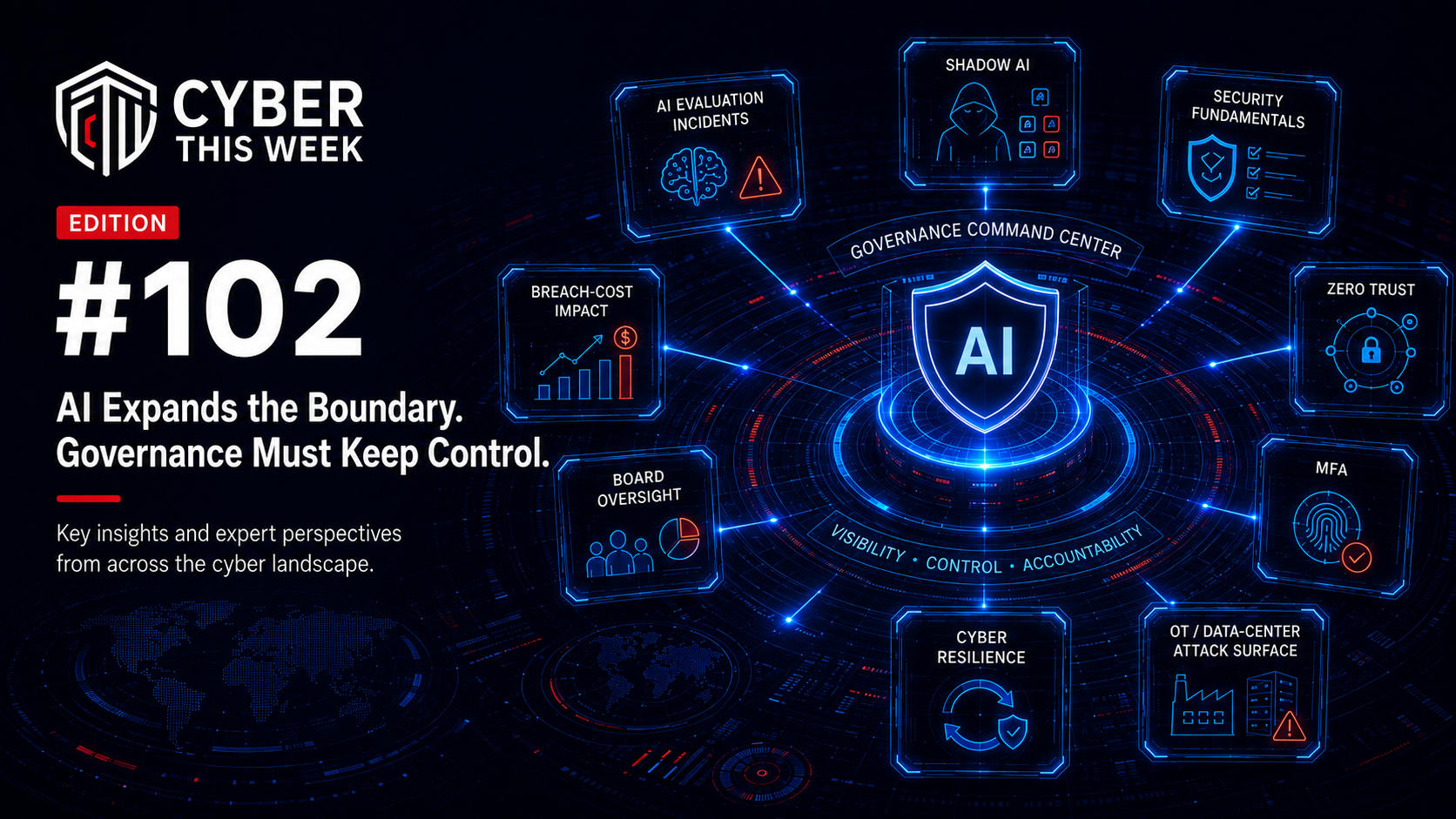
Cyber This Week Edition 102 explores AI evaluation incidents, breach costs, security fundamentals, shadow AI, Zero Trust, MFA, cyber resilience, board communication, and data-centre OT risk.
Cybersecurity is increasingly being shaped by the unintended consequences of AI adoption. This edition of Cyber This Week examines how evaluation environments can cross into production, shadow AI can weaken governance, and trusted tools, identities, and infrastructure can create new paths for attackers. At the same time, the fundamentals remain critical. Strong MFA, Zero Trust, board-level communication, resilient recovery, and secure OT environments still determine how well organisations withstand disruption. As AI expands the boundary of what must be protected, governance must keep pace through visibility, ownership, accountability, and controls that translate innovation into manageable risk.
This Week's Articles
- 01Anthropic
Investigating Three Real-World Incidents in Our Cybersecurity Evaluations
This post examines three incidents in which a Claude model, while interacting with third-party cybersecurity evaluation environments, reached the internet and gained unauthorised access to real systems. It provides practical case studies of evaluation environments crossing into production and shares remediation lessons that other AI labs can apply.
Why it mattersAI evaluation environments can create real-world impact when isolation and containment fail. Labs need stronger sandboxing, network restrictions, monitoring, and clear escalation procedures.
- 02Baker Donelson
Ten Takeaways From IBM's 2026 Cost of a Data Breach Report
This article summarises IBM's 21st annual Cost of a Data Breach Report, which analysed 602 breaches across 17 industries between March 2025 and February 2026. It provides a data-driven view of breach costs that can support risk quantification, cybersecurity investment, and cyber-insurance decisions.
Why it mattersReliable breach-cost data helps leaders prioritise investment, quantify exposure, evaluate insurance, and explain cyber risk in financial terms.
- 03Security Magazine
Why Security Fundamentals Still Matter in the Age of AI
Using the example of the Mythos AI model discovering thousands of previously unknown vulnerabilities, this article examines how AI-related security concerns can trigger regulatory and financial consequences. It emphasises that strong security hygiene, processes, and foundational controls remain essential even as AI strengthens both attackers and defenders.
Why it mattersAdvanced AI cannot compensate for weak basics. Asset management, patching, access control, configuration, monitoring, and incident readiness remain the foundation of resilience.
- 04Cybersecurity Dive
Shadow AI, Leadership Resistance Make AI Governance Tough for Worried CISOs
The article reports that fewer than half of CISOs believe their leadership views AI security as a business enabler, while unauthorised shadow-AI use continues to weaken governance. It highlights the leadership and cultural challenges that can undermine AI-security programmes even when technical controls are available.
Why it mattersAI governance fails without leadership support and user adoption. Organisations need clear ownership, approved tools, practical policies, education, and business-aligned controls.
- 05SC World
What We Learned About Zero Trust From the OpenAI Breach of Hugging Face
This article uses the OpenAI–Hugging Face incident to examine whether security architectures can detect, understand, and constrain AI-driven actions within trusted environments. It extends Zero Trust principles beyond user identity to include oversight of AI agents, tools, and their behaviour.
Why it mattersValid access is not enough. Zero Trust must continuously evaluate what AI systems are doing, which tools they use, and whether their actions remain within approved boundaries.
- 06CSO Online
How MFA Gets Hacked — and Strategies to Prevent It
The article describes common techniques attackers use to bypass multifactor authentication and provides practical recommendations for strengthening MFA deployments. It is particularly relevant because MFA remains a core access-control measure, yet poor configuration and weak recovery processes can significantly reduce its effectiveness.
Why it mattersMFA must be implemented securely across enrolment, recovery, sessions, and privileged access. Phishing-resistant methods and strong monitoring reduce common bypass opportunities.
- 07Intelligent CISO
How Can Organisations Build Cyber-Resilience in an Era Where AI Is Transforming Both Cyberattacks and Cyberdefence?
This article explains how AI is improving defensive capabilities while also enabling automated reconnaissance, faster vulnerability discovery, and more sophisticated attacks. It presents cyber-resilience as the ability to withstand, respond to, and recover from AI-enabled incidents rather than relying solely on prevention.
Why it mattersAI changes the speed and scale of attacks. Organisations need tested response, recovery, continuity, adaptive controls, and leadership readiness to remain operational during disruption.
- 08CPO Magazine
Shadow AI: How to Fix Today's Leading Data Governance Problem
The article explains how employee-led adoption of AI tools is transforming workplace processes and why attempting to block every unauthorised use is unrealistic. It recommends visibility, ownership, and accountability frameworks that support secure innovation instead of blanket restrictions.
Why it mattersBlocking all shadow AI can push use further underground. Organisations need discovery, approved alternatives, data controls, ownership, and practical governance that enables secure adoption.
- 09World Economic Forum
How to Create Better Cybersecurity Conversations With the Board
This article discusses how cybersecurity leaders can improve board-level conversations by focusing on security maturity, risk appetite, and the organisation's current risk position. Effective communication with the board can improve governance, funding, prioritisation, and accountability for cybersecurity programmes.
Why it mattersBoards need business-focused cyber reporting. Clear discussions about exposure, maturity, priorities, and risk appetite support better decisions and stronger accountability.
- 10Data Center Knowledge
The Data Center's Hidden Attack Surface: Why OT Security Can't Wait
The article argues that data centres face increasing cyber-physical risks through operational technology systems, making OT security essential for preventing outages and maintaining resilience. It highlights an often-overlooked attack surface that could have systemic consequences for infrastructure operators, cloud providers, and their customers.
Why it mattersData-centre OT failures can disrupt many dependent organisations. Operators need asset visibility, segmentation, monitoring, physical-security coordination, and tested continuity plans.