
Exposure Grows Faster. Security Must Act Earlier
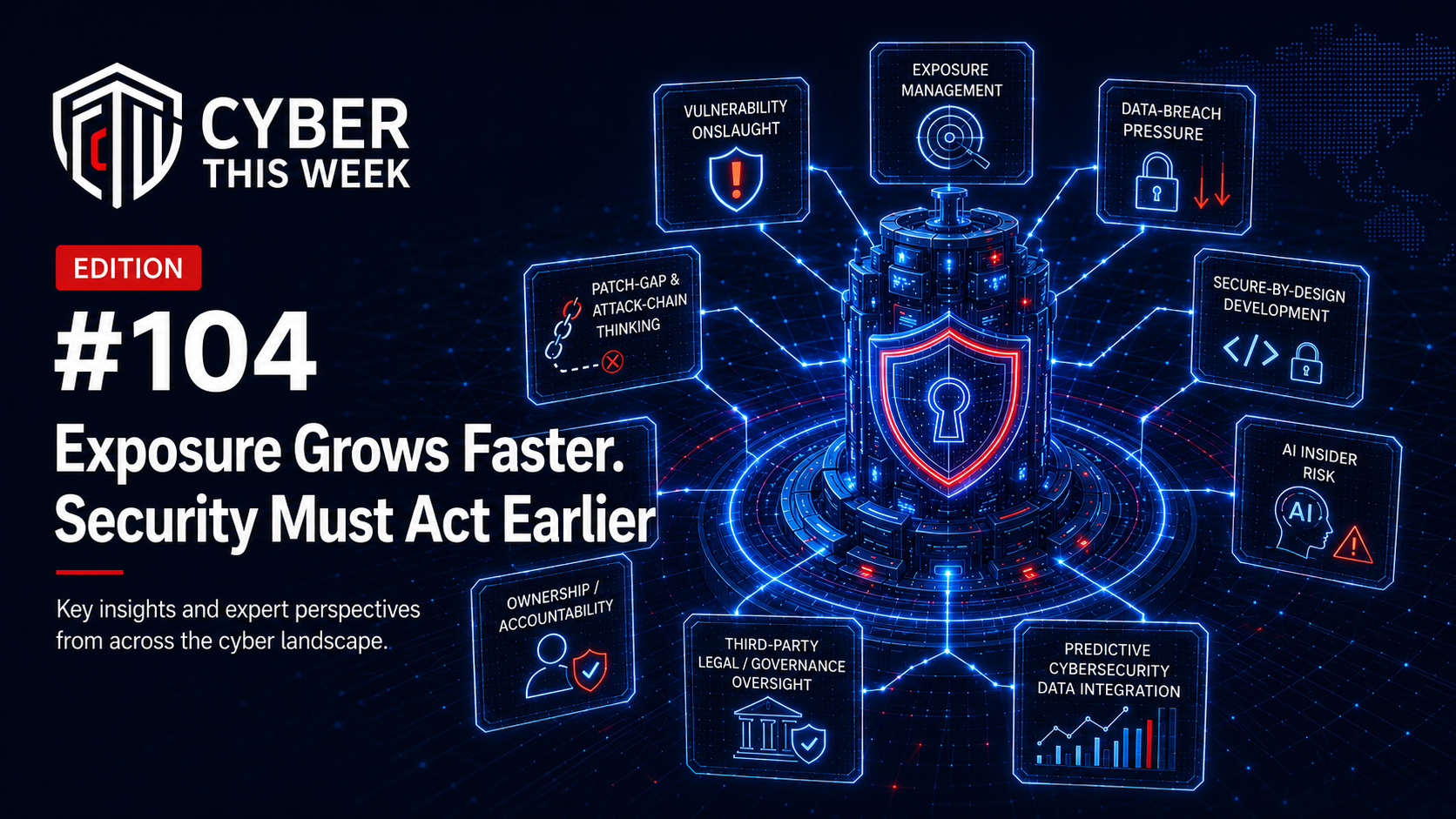
Cyber This Week Edition 104 explores proactive exposure management, AI-driven vulnerability discovery, breach pressure, attack-chain prioritization, secure development, AI insider risk, remediation ownership, third-party governance, and predictive cybersecurity.
Cybersecurity is shifting from finding problems to reducing exposure before attackers can exploit them. This edition of Cyber This Week examines how AI-driven vulnerability discovery, persistent breach pressure, patching gaps, insecure development, and expanding attack paths are forcing organisations to rethink how they prioritise and remediate risk. At the same time, accountability is becoming just as important as technology. AI insiders, outsourced security, unclear remediation ownership, and weak data integration all expose governance gaps that can slow action. As exposure grows faster, resilience depends on earlier intervention, secure-by-design practices, stronger ownership, and better use of data to prevent weaknesses from becoming incidents.
This Week's Articles
- 01SecurityInfoWatch
Detection Isn't Enough: Why Security Teams Must Get Proactive
This article argues that organizations must reduce vulnerabilities, configuration drift, and exploitable attack paths before attackers gain entry, rather than relying only on detection after compromise. It highlights proactive exposure management as a core requirement for modern cyber resilience.
Why it mattersSecurity teams need to reduce exploitable conditions before an attack begins. Continuous exposure management helps identify attack paths, prioritize weaknesses, and lower risk before compromise.
- 02SC World
Ready for the Flood: How Exposure Management Prepares You for the Mythos Vulnerability Onslaught
The article warns that AI-enabled vulnerability discovery could rapidly increase the number of memory-safety, injection, and authentication flaws security teams must address. It argues for risk-based exposure management that prioritizes attack paths and business-critical assets instead of treating every finding equally.
Why it mattersAI could increase vulnerability volume dramatically. Teams need risk-based prioritization focused on exploitable attack paths and critical assets rather than attempting to remediate every finding equally.
- 03Security Magazine
Data Breaches Could Set a Record in 2026
The article reports that the Identity Theft Resource Center tracked 1,803 data-compromise events in the first half of 2026, including 1,029 in Q2. It provides strong evidence of sustained breach pressure and is relevant for board reporting, security investment, and resilience planning.
Why it mattersSustained breach growth reinforces the need for stronger prevention, response, and recovery. The trend also provides useful context for board discussions and cybersecurity investment decisions.
- 04Dark Reading
The Patch Gap: Why Defenders Need to Think in Chains, Not Checklists
This article urges security teams to move beyond CVSS-only patch prioritization and focus on choke points that can disrupt attack chains leading to critical assets. It offers a more practical way to direct limited remediation resources toward real business risk.
Why it mattersNot every vulnerability carries equal business risk. Attack-chain analysis helps teams identify the weaknesses that matter most and focus limited remediation resources where they can break attacker pathways.
- 05Cybersecurity Dive
Secure Development Can Help Turn the Tables as AI Alters the Cyber Landscape
The article emphasizes memory-safe development and preventive engineering as essential defenses in an era when AI can identify software flaws more efficiently. Secure-by-design practices can reduce exploitable weaknesses before they enter production environments.
Why it mattersThe most effective vulnerability is one that never reaches production. Memory-safe development, secure coding, and preventive engineering reduce the attack surface before attackers can exploit it.
- 06InformationWeek
The AI Insider Risk Reshaping Financial Services
This article examines how AI agents operating with legitimate access can create internal security blind spots in financial workflows. It highlights the need for continuous monitoring and stronger controls over agent behavior, privileged data access, and transaction authority.
Why it mattersAI agents can create insider-like risk without malicious human intent. Organisations need behavioural monitoring, least privilege, transaction controls, and continuous oversight of autonomous activity.
- 07CSO Online
The Cybersecurity Backlog Is Not a Security Problem
The article argues that cybersecurity teams should provide risk oversight, while technology and business owners remain responsible for resolving weaknesses in the systems they own. Unclear remediation ownership can create vulnerability debt and weaken organizational accountability.
Why it mattersSecurity teams cannot own every remediation task. Clear accountability across technology and business owners is essential to reduce vulnerability backlogs and prevent unresolved risks from accumulating.
- 08CPO Magazine
Why It's Vital to Stay Secure Whilst AI Accelerates Innovation
This article explains how GenAI, cloud-native platforms, and hyperautomation are accelerating innovation while also improving attackers' ability to conduct reconnaissance and automate cyberattacks. It reinforces the need to embed security into transformation and AI-adoption programs from the outset.
Why it mattersInnovation moves faster when security is embedded early. Organisations should integrate security into AI, cloud, and automation programmes from design through deployment rather than adding controls later.
- 09JD Supra
Securing Your Interests in Your Cybersecurity Architecture: Litigation Risks Posed by Outsourcing the Protection of Your Networks, Systems, and Data
The article examines governance and litigation risks that arise when organizations outsource cybersecurity functions to managed providers and other third parties. It stresses the importance of strong contracts, security requirements, audit rights, oversight mechanisms, and clearly defined incident-response responsibilities.
Why it mattersOutsourcing cybersecurity does not outsource accountability. Contracts, audit rights, security requirements, and incident responsibilities must clearly define how third-party risks are governed.
- 10Forbes Technology Council
Why Data Integration for Predictive Cybersecurity Fails—And How to Make It Work
This article explores why security-data integration and AI-driven predictive cybersecurity programs often fail to deliver useful results. It highlights the need for better data quality, architecture, and integration practices to make predictive security initiatives effective.
Why it mattersPredictive cybersecurity depends on trustworthy data. Poor integration, inconsistent telemetry, and weak architecture can undermine AI-driven security initiatives before the analytics even begin.