
Speed Shrinks the Window. Resilience Must Move Faster.
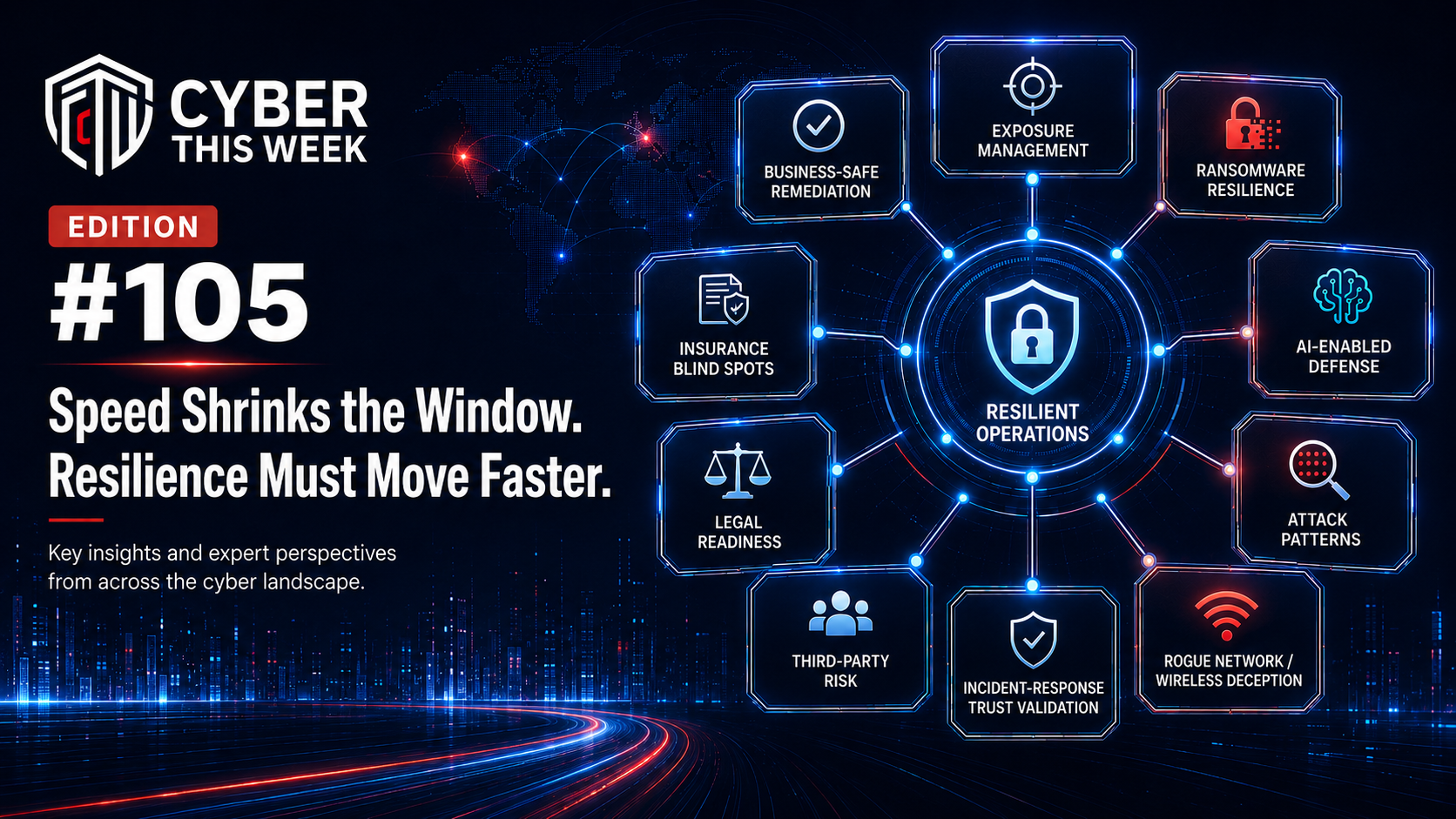
Cyber This Week Edition 105 explores AI-driven exposure, rapid remediation, ransomware resilience, agentic SOCs, AI attack patterns, cyber-insurance gaps, breach communications, recovery fraud, third-party risk, and rogue wireless networks.
Cybersecurity is moving into an environment where the time between discovery, exploitation, and business impact is rapidly shrinking. This edition of Cyber This Week examines how AI-driven vulnerabilities, agentic security operations, ransomware, and evolving attack patterns are forcing organisations to respond faster without sacrificing stability or control. At the same time, resilience now extends beyond technology. Insurance gaps, legal exposure, third-party dependencies, recovery fraud, and insecure connectivity can all magnify the impact of an incident. As the window to act gets smaller, organisations need faster triage, stronger continuity planning, trusted response partners, and coordinated decision-making across security, legal, operations, and leadership.
This Week's Articles
- 01SecurityInfoWatch
Why Traditional Vulnerability Management Fails in an AI-Enabled Threat Environment
The article argues that traditional, periodic vulnerability-management processes are inadequate as AI accelerates vulnerability discovery and exploitation. It calls for a shift toward exposure management and attack-path reduction, focusing on real risk pathways rather than waiting for perfect controls or regulation.
Why it mattersPeriodic scanning is no longer sufficient when vulnerabilities can be discovered and exploited faster. Organisations need continuous exposure management focused on attack paths, critical assets, and practical risk reduction.
- 02Forbes Technology Council
The New Currency Of Cybersecurity Is Speed, But Only If The Fix Doesn’t Break Production
The article explains that exploitation is increasingly happening before patches are available, while remediation can still take weeks or months. It emphasizes compensating controls, rapid risk triage, tested emergency changes, and business-aware remediation to reduce the exposure window without disrupting production.
Why it mattersRemediation speed matters, but uncontrolled changes can create operational damage. Security teams need tested emergency processes, compensating controls, and business-aware prioritisation.
- 03CIO
Ransomware Takes Aim at Enterprise Resilience
This article argues that ransomware has evolved from a data-encryption problem into a broader business-disruption strategy. Effective resilience now depends on operational continuity, recovery capability, executive decision-making, and supplier coordination, not just technical containment.
Why it mattersRansomware increasingly targets business operations rather than only data. Recovery planning, supplier coordination, executive decision-making, and continuity capability are therefore core security controls.
- 04SC World
The Agentic SOC: How to Build Machine-Speed Defense for the AI Era
The article highlights the growing mismatch between AI-accelerated attacks and human-speed security operations. It presents agentic SOC capabilities as a way to improve detection, investigation, and response speed while retaining appropriate governance and human oversight.
Why it mattersAI-enabled attackers can operate faster than traditional SOC workflows. Agentic capabilities can help defenders accelerate investigation and response while maintaining human oversight and governance.
- 05Security Magazine
5 AI Attack Patterns Organizations Can’t Ignore
This article outlines how AI is changing trust, access, execution, and deception across the threat landscape. It helps security teams build threat models and controls for AI-enabled social engineering, identity abuse, misuse, and increasingly autonomous attack activity.
Why it mattersAI changes how attackers exploit trust and access. Organisations need updated threat models that address AI-enabled deception, identity abuse, autonomous activity, and misuse.
- 06Insurance Asia
How Cyber Insurance Gaps Can Leave Factory Damage Uncovered
The article explains how ransomware affecting factory operations can cause machinery stoppages, production losses, and supply-chain disruption that may fall between cyber and property insurance policies. It highlights the need to map OT scenarios to both cybersecurity controls and insurance coverage.
Why it mattersCyber incidents can create physical and operational losses that may not fit neatly within one insurance policy. Organisations should map OT scenarios against both cyber and property coverage before an incident occurs.
- 07CSO Online
What You Say During a Cyber Breach Can — and Will — Be Used Against You
The article warns that incident communications and documentation can become damaging legal evidence if privilege and records are poorly managed. It stresses the importance of aligning legal counsel, incident-response procedures, communication protocols, and records management before a breach occurs.
Why it mattersIncident communications can create legal exposure. Security, legal, communications, and leadership teams should establish privilege, documentation, and communication procedures before a crisis begins.
- 08Cybersecurity Dive
Ransomware Disproportionately Targets Medium-Sized Firms, Straining Customer Relationships
This article examines the pressure ransomware places on mid-sized companies that operate within complex customer and supplier ecosystems. It highlights how weak security and resilience can damage commercial relationships and create cascading third-party and supply-chain risks.
Why it mattersA ransomware incident can affect customers and suppliers far beyond the victim organisation. Mid-sized firms need resilience and third-party risk controls that protect both operations and commercial trust.
- 09Dark Reading
'Ransom Busters': Ransomware Actor Poses as Incident-Recovery Service
The article describes a ransomware affiliate allegedly posing as an incident-recovery provider in an attempt to divert ransom payments. It reinforces the importance of validating recovery vendors, advisers, payment intermediaries, and communication channels during ransomware incidents.
Why it mattersAttackers can exploit the confusion surrounding incident recovery itself. Organisations should pre-vet recovery partners and independently verify advisers, payment channels, and communications during a crisis.
- 10Aerospace Global News
Delta’s Fake WiFi Incident Exposes a Wider Airline Cybersecurity Threat
The article uses a fake in-flight Wi-Fi incident to illustrate the risks posed by “evil twin” access points and deceptive wireless networks. It highlights the need for stronger traveller awareness, wireless-network verification, and secure connectivity practices, especially for travel-intensive organizations.
Why it mattersRogue wireless networks can exploit user trust outside the corporate perimeter. Organisations should strengthen traveller guidance, secure connectivity practices, VPN use, and wireless-network verification.