
Fragmented Security Slows Response. Integrated Resilience Builds Trust.
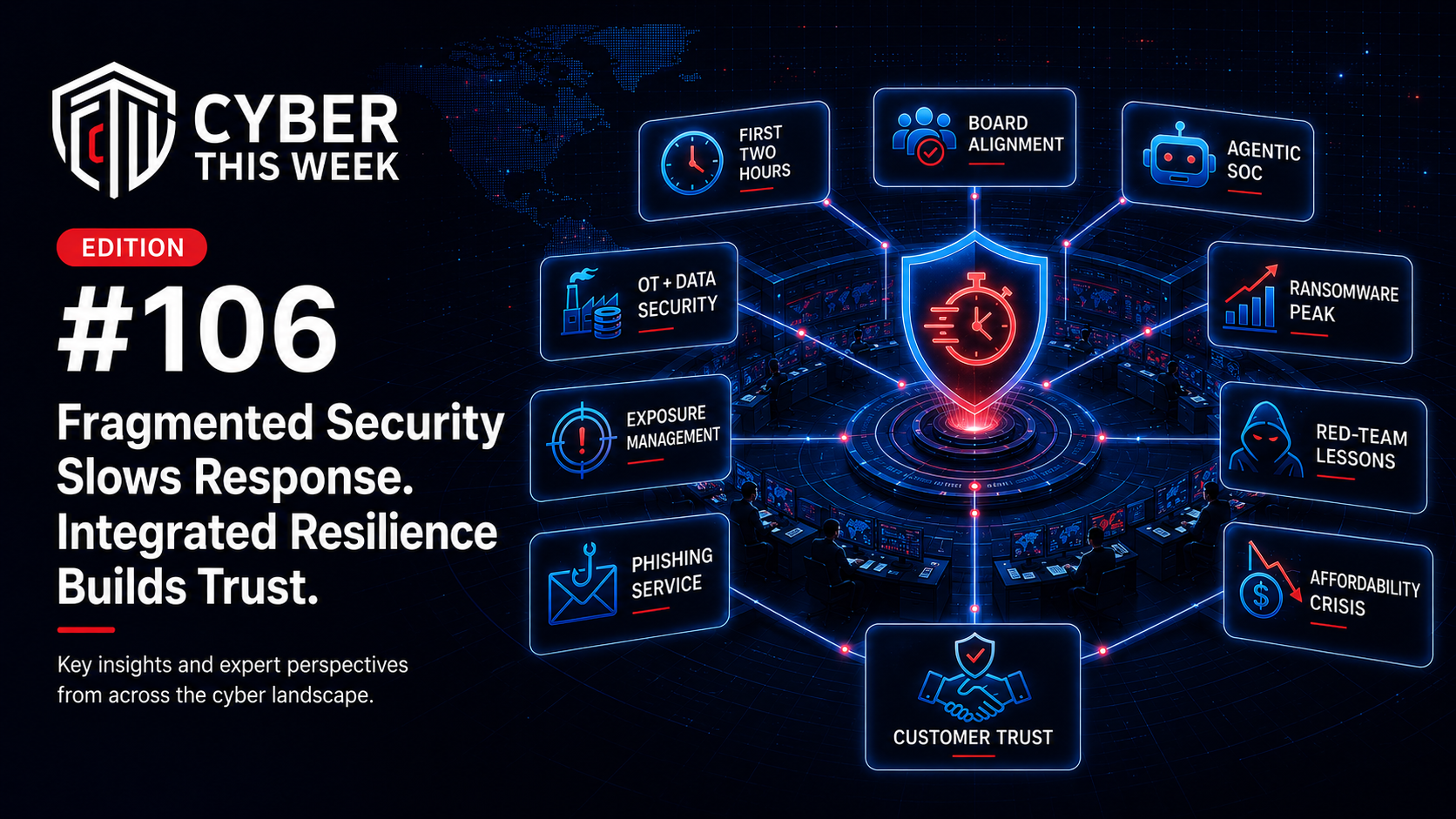
Cyber This Week Edition 106 explores rapid incident response, fragmented security strategy, agentic SOCs, OT and data convergence, exposure management, phishing-as-a-service, ransomware, red-team lessons, affordability, and customer trust.
Cybersecurity resilience increasingly depends on how quickly organisations can coordinate people, technology, and decisions under pressure. This edition of Cyber This Week examines the critical first hours of incident response, fragmented security strategies, agentic AI in the SOC, rising ransomware activity, phishing-as-a-service, and the growing convergence of OT, data, and AI risk. At the same time, visibility, affordability, and trust are becoming strategic concerns. Red-team lessons, exposure-management platforms, budget pressures, and privacy-by-design all point to the same conclusion: stronger security comes from integrated governance, faster response, and systems designed to sustain confidence before, during, and after disruption.
This Week's Articles
- 01InformationWeek
Incident Response: Why the First Two Hours After an Attack Set the Tone
The article argues that the first 120 minutes after detection can determine whether a cyberattack remains manageable or escalates into prolonged disruption. It stresses the need for pre-arranged breach counsel, forensic support, secure communications, and clear decision protocols that can be activated immediately.
Why it mattersThe first two hours can shape the entire incident outcome. Organisations need breach counsel, forensic support, secure communications, escalation paths, and decision authority ready before an attack occurs.
- 02World Economic Forum
What Are the Hidden Costs of a Fragmented Cybersecurity Strategy?
This article explains that cyber risk is now a board-level business issue, yet many organizations still operate fragmented security programs. It highlights the hidden costs of misaligned budgets, tools, and processes, and argues for a more integrated, business-aligned cybersecurity strategy.
Why it mattersFragmented tools, budgets, and ownership increase cost while slowing response. Integrated security strategy helps align cyber investment with business risk and resilience priorities.
- 03SecurityInfoWatch
The SOC Is Entering the Age of Agentic AI
The article examines how autonomous AI agents are challenging traditional assumptions about security operations and detection. It argues that SOCs must evolve to govern and constrain machine-driven actions in real time, rather than only investigating suspicious activity after the fact.
Why it mattersAgentic AI changes the SOC from observing activity to governing autonomous actions. Security teams need policy enforcement, behavioural controls, continuous monitoring, and human oversight.
- 04CISO MAG
Model-Borne Consequence: Why OT Security and Data Security Just Became the Same Job
This article argues that AI is eroding the traditional separation between OT cybersecurity and IT/data security. As AI models and data flows increasingly influence physical processes, organizations need shared governance across operational technology, data, and AI systems.
Why it mattersAI connects data decisions with physical outcomes. OT, data, and AI security can no longer be governed in isolation when model behaviour can influence real-world operations.
- 05SC World
How to Evaluate Endpoint Exposure, Hardening, and Patch Management Platforms
The article proposes a practical framework for assessing exposure-management platforms based on whether they can answer five key governance questions: what exists, why it exists, who owns it, what is being done, and whether the issue has returned. It helps CISOs distinguish genuine exposure control from basic visibility.
Why it mattersVisibility alone is not exposure management. Effective platforms should connect assets, ownership, remediation, and recurring risk so leaders can understand whether exposure is actually being reduced.
- 06Security Magazine
A Look Inside the Phishing Service Attacking Organizations
This research examines NovaCookies, a subscription phishing service that reportedly sells real-time Microsoft 365 session theft capabilities for around $320 per month. It demonstrates how low-cost, commoditized services are making sophisticated identity attacks accessible at scale.
Why it mattersAdvanced identity attacks are becoming inexpensive and accessible. Organisations need phishing-resistant MFA, session protection, identity monitoring, and stronger controls around account recovery and access.
- 07Computer Weekly
Ransomware Attack Volumes Hit ‘High-Water Mark’ in July
The article reports that ransomware attack volumes reached their highest level of the year in July. It serves as a threat-intelligence signal reinforcing the need for stronger resilience, backup, recovery, and incident-response readiness.
Why it mattersHigh ransomware volumes reinforce the need to assume disruption is possible. Tested backups, recovery procedures, continuity planning, segmentation, and response readiness remain essential.
- 08Cybersecurity Dive
CISA Identifies Security Hurdles That Led to Very Different Results in Two Red-Team Engagements
This article examines lessons from two CISA red-team exercises in which different security postures produced significantly different outcomes. It highlights practical factors such as visibility, segmentation, and response speed that can materially affect the impact of a compromise.
Why it mattersSmall differences in visibility, segmentation, and response capability can dramatically change attack outcomes. Red-team exercises provide practical evidence of which controls actually reduce impact.
- 09Dark Reading
Is Cyber Facing an Affordability Crisis?
The article explores how rising breach costs and cybersecurity spending are leaving smaller businesses increasingly exposed. It highlights the broader systemic risk created when resource-constrained firms become weak links within supply chains and business ecosystems.
Why it mattersCybersecurity affordability is becoming an ecosystem risk. Resource-constrained firms can become weak links for larger partners, making scalable controls and shared resilience increasingly important.
- 10CSO Online
Beyond Compliance: Designing Systems That Earn Customer Trust
This article argues that privacy and customer trust require end-to-end system design that consistently respects user choices across data collection, processing, and use. It emphasizes trust as a design and governance objective rather than a narrow compliance requirement.
Why it mattersCompliance alone does not create trust. Organisations need privacy and user choice embedded into system design, data flows, governance, and operational decision-making.