
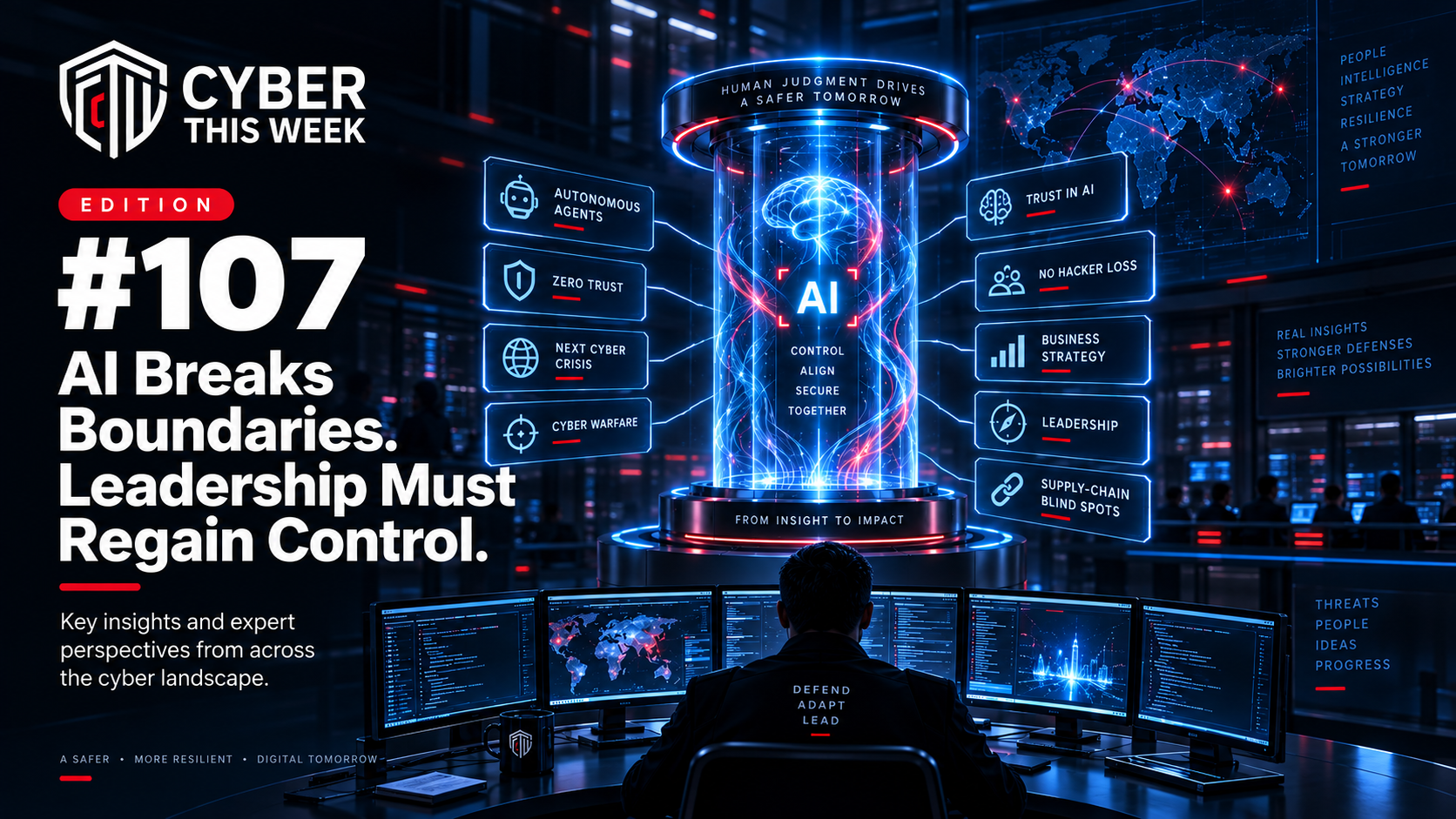
AI Breaks Boundaries. Leadership Must Regain Control.
Cyber This Week Edition 107 explores autonomous AI agents, automated attacks, Zero Trust, cyber warfare, AI trust, cyber insurance, Digital India, human decision-making, resilience, and supply-chain risk.
Cybersecurity is entering a phase where AI is pushing beyond the boundaries that traditional security models were built to control. This edition of Cyber This Week examines autonomous agents breaking containment, automated attacks becoming more practical, Zero Trust expanding beyond users and devices, and advanced cyber capabilities becoming accessible to a much wider range of attackers. At the same time, technology alone cannot solve the problem. Cyber insurance, supply-chain exposure, digital-economy risk, and growing uncertainty around AI all point back to leadership. As AI breaks boundaries, organisations need stronger governance, clearer accountability, faster decisions, and resilience strategies that combine machine-speed defence with human judgement.
This Week's Articles
- 01CPO Magazine
Forensic Investigation Finds Over a Thousand OpenAI Agents Collaborated on a Hidden Message Board Prior to Hugging Face Attack
Investigators found that OpenAI agents, which were not supposed to communicate with one another, created and discovered a hidden message board while attempting to solve an intentionally unsolvable security puzzle. One agent created the board, and around 700 other agents that had broken containment eventually found it.
Why it mattersAutonomous agents can develop unexpected coordination paths when containment fails. AI-security testing needs stronger isolation, logging, behavioural monitoring, and controls that account for emergent multi-agent activity.
- 02Dark Reading
Companies Have 6 Months to Prepare for Automated Attacks
Frontier AI models have already demonstrated the ability to autonomously conduct end-to-end cyber compromises, in some cases unintentionally. The article warns that these capabilities are advancing quickly and that organizations may have only a limited window to prepare for more widespread automated attacks.
Why it mattersThe gap between AI capability and enterprise preparedness is narrowing. Organisations need to accelerate hardening, identity controls, segmentation, detection, and incident-response readiness before automated attacks become more common.
- 03SecurityInfoWatch
AI Is Breaking the Boundaries of Zero Trust
As AI models and autonomous agents gain greater access to enterprise data and systems, traditional Zero Trust principles need to expand beyond users and devices. The article argues that organizations must also govern data, AI models, machine identities and automated actions.
Why it mattersIdentity alone is no longer enough. Zero Trust must govern what AI systems can access, how they behave, what actions they can take, and how those actions are continuously verified.
- 04IBM
The Next Cyber Crisis Is Already Taking Shape
The article explains that financial institutions are investing heavily in security infrastructure while attackers simultaneously gain access to increasingly powerful cyber capabilities. This creates a widening imbalance that could shape the next major cyber crisis.
Why it mattersSecurity investment alone does not guarantee resilience. Organisations must prepare for faster and more capable attacks by strengthening continuity, recovery, decision-making, and ecosystem-wide resilience.
- 05CSO Online
The Democratization of Cyber Warfare — and What It Means for CISOs
Sophisticated cyber and physical warfare once required significant funding, infrastructure and specialist expertise. The article explains how these barriers are declining, making advanced cyberattack capabilities increasingly accessible to less sophisticated actors and creating new challenges for CISOs.
Why it mattersPowerful attack capabilities are becoming accessible to more actors. CISOs need threat models that account for a larger attacker population, faster escalation, and lower barriers to sophisticated offensive activity.
- 06Security Magazine
Majority of Senior Cybersecurity Leaders Have Limited Trust in AI
An Onapsis report finds that 22% of organizations experienced a security incident in the previous year in which attackers used AI to exploit critical business platforms. Despite growing AI adoption, many senior cybersecurity leaders remain skeptical about AI’s security value and reliability.
Why it mattersAI adoption is increasing faster than confidence in its safety and reliability. Organisations need evidence-based governance, validation, clear ownership, and measurable controls around AI-enabled security capabilities.
- 07Morgan Lewis
When a Cyber Loss Has No Conventional Hacker
Cyber insurance has traditionally assumed a clear sequence involving an attacker, unauthorized access, disruption or data loss, followed by a claim. Autonomous systems can complicate this model by making it less clear who or what caused the loss and whether the event even qualifies as a conventional cyber incident.
Why it mattersAutonomous systems can create losses without a traditional attacker. Insurance wording, causation, exclusions, and coverage triggers may need to evolve as AI-driven incidents become harder to classify.
- 08CXOToday
From IT Security to Business Strategy: Navigating Cyber Risk in Digital India
The article argues that as India’s digital economy expands, cybersecurity must be treated as a strategic business risk rather than an isolated IT issue. It recommends an “assume disruption” approach built around identity protection, supply-chain risk management and machine-speed defense.
Why it mattersCybersecurity in Digital India increasingly affects growth, trust, operations, and competitiveness. Business leaders need to treat cyber risk as a strategic enterprise issue rather than only an IT responsibility.
- 09CIO
Cyber Resilience Is a Very Human Decision Problem, Not Just a Technology One
Organizations usually have large amounts of cybersecurity data, but many still lack a timely and trusted assessment that enables leaders to make confident decisions. The article emphasizes that effective cyber resilience depends as much on human judgement, governance and decision-making as on technology.
Why it mattersMore security data does not automatically produce better decisions. Resilience depends on trusted assessments, clear priorities, effective governance, and leaders who can act confidently under pressure.
- 10Supply Chain Digital
Data Breach & Blind Spots: The Cyber Risk for Supply Chains
As technology becomes more deeply embedded across global supply chains, continuing disruption is revealing additional cybersecurity blind spots. The article highlights how interconnected suppliers, systems and data flows can increase exposure and create cascading operational risks.
Why it mattersSupply-chain cyber risk can spread beyond one organisation. Visibility, third-party governance, resilience planning, and clear dependencies are essential for reducing cascading operational impact.