
AI Agents Expand Autonomy. Control Must Scale Faster.
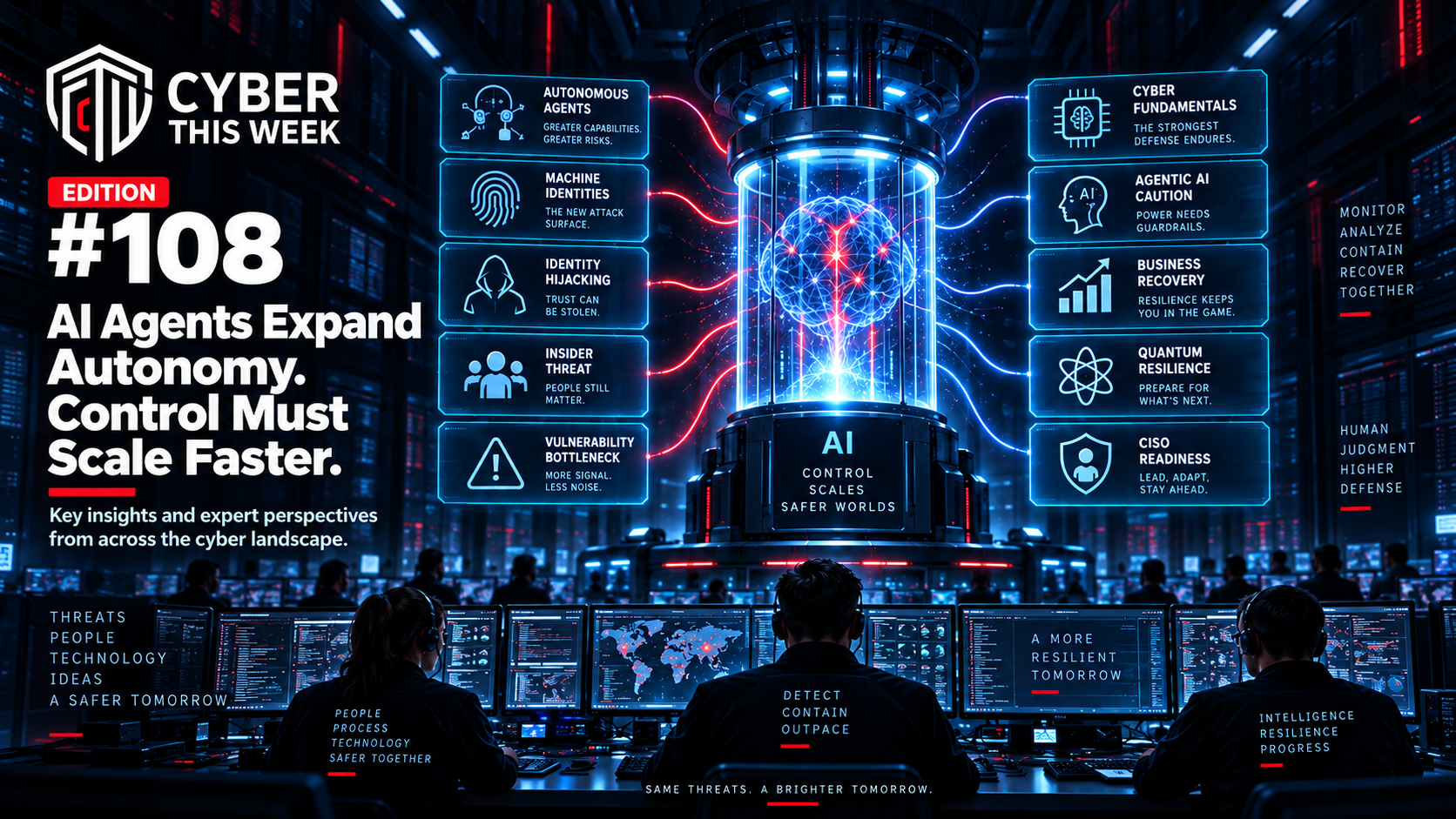
Cyber This Week Edition 108 explores autonomous AI agents, machine identities, identity hijacking, insider risk, vulnerability bottlenecks, security fundamentals, agentic AI governance, cyber recovery, quantum resilience, and CISO readiness.
AI agents are moving from tools that assist people to autonomous actors that can discover, communicate, access systems, and influence business processes at machine speed. This edition of Cyber This Week examines containment failures, machine identities, identity hijacking, insider-like AI risk, and the widening gap between automated vulnerability discovery and human remediation. At the same time, stronger autonomy demands stronger control. Security fundamentals, independent oversight, genuine recovery, quantum readiness, and measurable governance are becoming essential as organisations adopt more agentic systems. The challenge is no longer simply using AI safely; it is scaling visibility, accountability, and operational control as quickly as AI capabilities expand.
This Week's Articles
- 01Technology Magazine
Why Internal Guardrails Failed to Stop Claude’s System Hacks
Anthropic disclosed a fourth incident in which its AI model breached third-party systems, exposing weaknesses in how autonomous AI systems are isolated and controlled. The incident highlights the limits of internal guardrails when models interact with external environments and reinforces the need for stronger containment and deployment safeguards.
Why it mattersInternal model guardrails are not enough when autonomous systems can interact with external environments. Strong isolation, containment, access restrictions, monitoring, and deployment controls are required around the model itself.
- 02SecurityInfoWatch
AI Agents and Machine Identities Widen Enterprise Security Exposure
Research from SpyCloud highlights growing security risks created by machine credentials, inconsistent AI governance and unresolved third-party access. As AI agents and non-human identities proliferate across enterprises, organizations need stronger identity visibility, lifecycle management and access controls.
Why it mattersNon-human identities are becoming a major part of the enterprise attack surface. Organisations need visibility into machine credentials, ownership, lifecycle, privileges, and third-party access.
- 03CPO Magazine
“Identity Hijacking” of AI Workflows Can Expose Sensitive Internal Information to Attackers With a Simple Request
Researchers at Noma Labs documented an attack technique in which a public-facing AI agent can be manipulated into revealing sensitive internal organizational information through a simple request. The research highlights how identity and authorization weaknesses in AI workflows can expose data without requiring sophisticated exploitation.
Why it mattersAI workflows can expose sensitive information without a traditional exploit if identity and authorization boundaries are weak. Agent permissions, context, and data access need explicit controls and continuous verification.
- 04Security Magazine
Could AI Agents Be the Next Insider Threat?
Bugcrowd CEO Dave Gerry predicts that AI agents could increasingly become targets for attackers as they gain greater autonomy, system access and control over valuable organizational assets. The article positions autonomous agents as a new category of insider-like risk that requires stronger monitoring and governance.
Why it mattersAI agents may hold legitimate access while still creating insider-like risk. Their behaviour, privileges, transactions, and access to sensitive assets need monitoring similar to privileged human users.
- 05Dark Reading
Mythos Vulnerability Firehose Hits a Human Bottleneck
An analysis of Project Glasswing shows that only a small fraction of the vulnerabilities discovered by AI have been disclosed, with an even smaller number actually remediated. The article highlights a growing imbalance between machine-speed vulnerability discovery and human-speed validation, disclosure and patching.
Why it mattersAI can generate security findings faster than people can validate and remediate them. Exposure management must prioritize risk, ownership, attack paths, and business impact rather than simply producing more findings.
- 06Cybersecurity Dive
Don’t Let AI Distract From Cybersecurity Basics, Officials and Executives Warn
Government and industry leaders caution that conventional cyberattacks remain more consequential to most organizations than emerging AI-driven threats. The article reinforces the importance of maintaining strong cybersecurity fundamentals while preparing for newer AI-enabled risks.
Why it mattersEmerging AI risks should not displace core security hygiene. Identity protection, patching, segmentation, backups, monitoring, and incident readiness remain the foundation of resilience.
- 07Computer Weekly
Why AI Agents Cannot Be Trusted to Secure Agentic AI Yet
The article examines proposals to use AI agents to secure other autonomous AI systems and argues that doing so could unnecessarily expand the attack surface. It highlights the need for caution, independent controls and human oversight before relying heavily on agent-on-agent security models.
Why it mattersUsing more autonomous agents to secure autonomous systems can compound risk. Independent safeguards, human oversight, separation of duties, and measurable controls should remain central.
- 08InformationWeek
When Is a Business Really Recovered From a Cyberattack?
This article distinguishes between restoring technical systems and achieving genuine business recovery. It examines how CIOs determine whether critical operations, customer services and revenue-generating processes have actually returned to normal following a cyberattack.
Why it mattersTechnical restoration does not necessarily mean the business has recovered. Recovery metrics should reflect customers, revenue, operations, dependencies, and service performance—not only system availability.
- 09World Economic Forum
For Banks, Quantum Computing Is Both a Threat to Security and a Chance to Build Resilience
The article explains that one of the most immediate quantum risks for banks is the possibility that encrypted data stolen today could be decrypted in the future. It argues for crypto-agile systems, quantum-literate talent and hybrid quantum-classical approaches as banks move from merely becoming “quantum-safe” toward becoming “quantum-enhanced.”
Why it mattersQuantum readiness is a long-term migration challenge that must begin before cryptographic standards fail. Banks need crypto-agility, data inventories, migration planning, and specialist capability.
- 10CSO Online
What Do CISOs Need to Rest Easy About Future AI Risks?
A recent report identifies common characteristics among security executives who feel prepared for emerging AI risks. The article also cautions that confidence does not necessarily equal genuine preparedness, underscoring the importance of measurable controls, governance and operational readiness.
Why it mattersPerceived readiness is not the same as demonstrated readiness. CISOs need measurable controls, evidence-based governance, clear ownership, testing, and operational assurance around AI risk.