
Prevention Isn’t Enough. Recovery Preserves Trust.
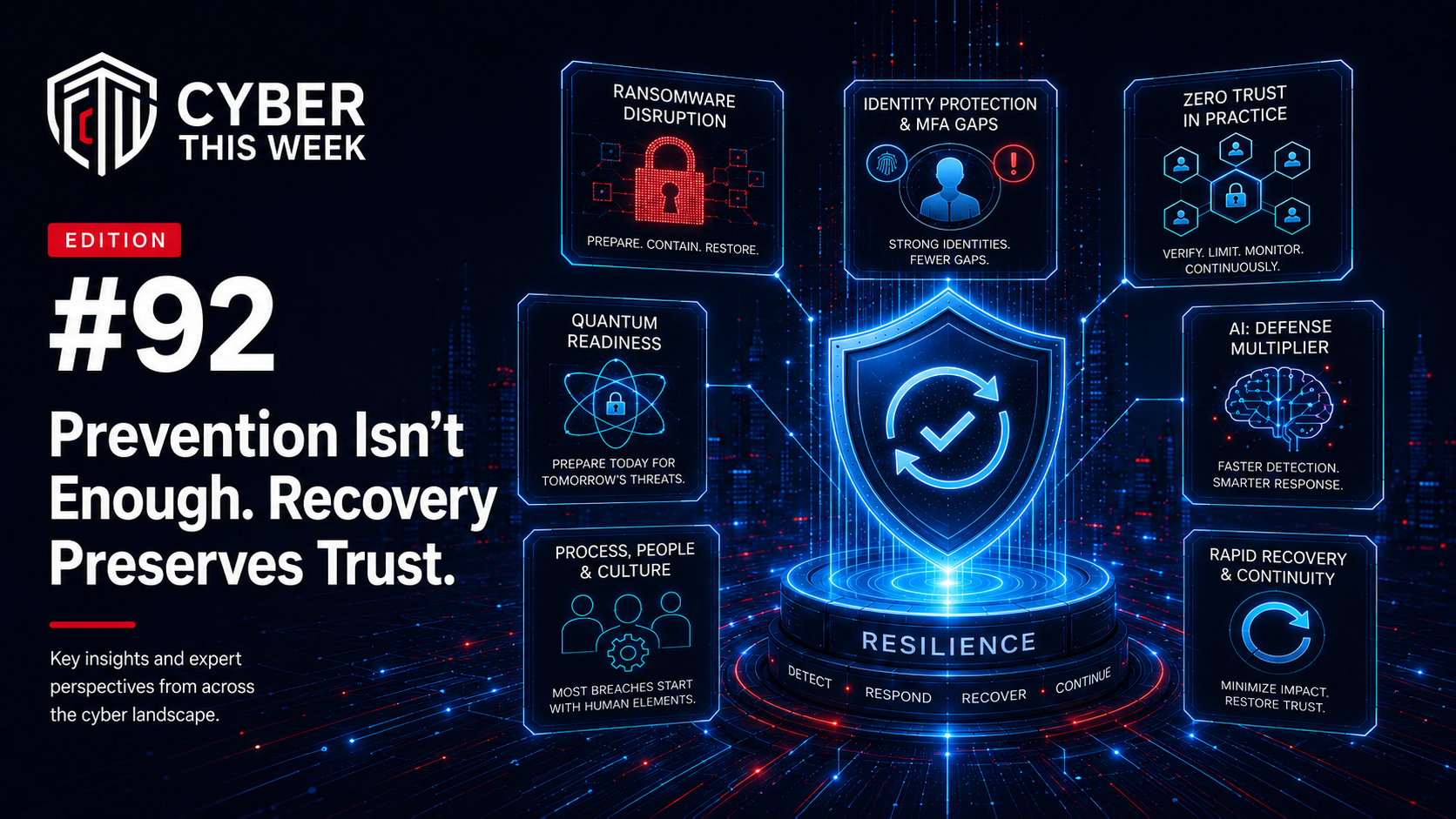
Cyber This Week Edition 92 explores ransomware disruption, AI insurance, MFA identity gaps, vulnerability visibility, zero trust, quantum readiness, AI security, recovery, security culture, and generative AI defence.
Cybersecurity is increasingly becoming a question of resilience, not just resistance. This week’s Cyber This Week reflects on how organisations are being tested not only by evolving attack methods, but by the assumptions embedded within their systems, cultures, and recovery strategies. From ransomware disrupting global operations to identity gaps bypassing traditional MFA protections, and from the growing paradox of zero trust to the emerging realities of quantum readiness, the landscape continues to evolve in unexpected ways. At the same time, AI is reshaping both offence and defence, while organisations are realising that processes, culture, and recovery capabilities may matter more than any individual control. The conversation is shifting from “Can we stop every attack?” to “Can we sustain trust, continuity, and clarity when disruption arrives?”
This Week's Articles
- 01CPO Magazine
Cyber Attack by Nitrogen Ransomware Hits Foxconn, Disrupting North American Operations
The Nitrogen ransomware group claimed responsibility for an attack that disrupted Foxconn’s North American operations. The attackers also claimed to have stolen eight terabytes of data containing more than 11 million documents.
Why it mattersLarge-scale ransomware incidents can interrupt operations while creating significant data-loss, regulatory, and recovery consequences. Organisations need tested containment and continuity plans.
- 02Insurance Journal
AI Insurance Is Not Cyber Insurance With Extra Steps
The article argues that AI-related risks should not simply be treated as conventional cyber risks. Emerging litigation shows that AI can create distinct legal, operational, privacy, and insurance exposures requiring different coverage approaches.
Why it mattersAI losses may not fit traditional cyber-insurance assumptions. Organisations need to understand coverage definitions, exclusions, and liability across AI-enabled operations.
- 03Security Magazine
Reframing MFA Bypass: Four Identity Gaps Attackers Exploit
Many incidents described as “MFA bypasses” actually exploit weaknesses surrounding authentication, including session theft, phishing relays, account-recovery processes, and fraudulent identity enrolment. Effective protection therefore requires controls across the entire identity lifecycle.
Why it mattersMFA alone cannot protect weak identity processes. Organisations need secure enrolment, recovery, session management, continuous verification, and stronger monitoring.
- 04CSO Online
Why Some Security Fixes Never Reach Your Vulnerability Dashboard
The traditional CVE system was designed primarily for clearly identifiable software vulnerabilities. It is increasingly struggling to represent modern supply-chain incidents, malware-related fixes, AI assets, and agent infrastructure, leaving some important security issues absent from vulnerability dashboards.
Why it mattersSecurity teams may assume that dashboards provide complete visibility when important risks are not represented. Exposure management must look beyond conventional CVE-based reporting.
- 05CIO
The Zero-Trust Paradox: Why Systems Built to Eliminate Trust May Be Destroying It
Although zero-trust models improve technical security, continuously treating employees as potential threats can create a culture of surveillance and weaken trust within the organisation. The article explores how companies can balance security controls with employee experience.
Why it mattersSecurity controls can fail when they damage culture or encourage workarounds. Zero trust should strengthen verification without undermining employee confidence and collaboration.
- 06InformationWeek
Quantum Computing Faces Security, Skills Shortage Problem
Quantum computing is advancing toward capabilities that could undermine existing cryptographic systems. At the same time, organisations face a shortage of professionals with the specialised skills required to prepare infrastructure for post-quantum security.
Why it mattersPost-quantum preparation requires technical planning and skilled people. Delayed action may leave organisations with large cryptographic migration challenges later.
- 07SecurityInfoWatch
4 AI Security Lessons From the Front Lines of Cybersecurity
Cybersecurity experts from organisations including Microsoft, OWASP, UnixGuy, and TryHackMe discuss practical lessons for securing AI. The article recommends treating AI security as an evolving professional capability rather than approaching it primarily through fear.
Why it mattersAI security requires continuous learning, practical testing, and updated skills. Organisations should build capability instead of relying on fear-driven restrictions or assumptions.
- 08SC World
Recovery Is the New Cyber Deterrence
Effective cyber deterrence depends not only on preventing attacks but also on demonstrating that an organisation can recover rapidly and preserve its strategic objectives. Strong recovery capabilities reduce the value an adversary can gain from disruption.
Why it mattersAttackers gain less leverage when disruption does not produce lasting impact. Recovery speed, continuity, and decision readiness are becoming core defensive capabilities.
- 09Dark Reading
Processes and Culture Top Reasons Behind Data Breaches
Security incidents frequently result from weak organisational processes, poor workplace culture, and insufficient visibility rather than the absence of individual security tools. The article highlights the importance of operational discipline and shared security responsibility.
Why it mattersTechnology cannot compensate for unclear ownership, weak processes, or poor reporting culture. Sustainable resilience depends on how people work and make decisions.
- 10Forbes Technology Council
Four Ways That Generative AI Improved Cybersecurity Forever
Generative AI is transforming cybersecurity by helping defenders anticipate attacks, interpret identity context, identify sensitive information, and discover complex software vulnerabilities. These capabilities allow threats to be understood and addressed at machine speed.
Why it mattersAI can improve defensive speed and context when used responsibly. Security teams need governance, trustworthy data, and human oversight to gain these benefits safely.