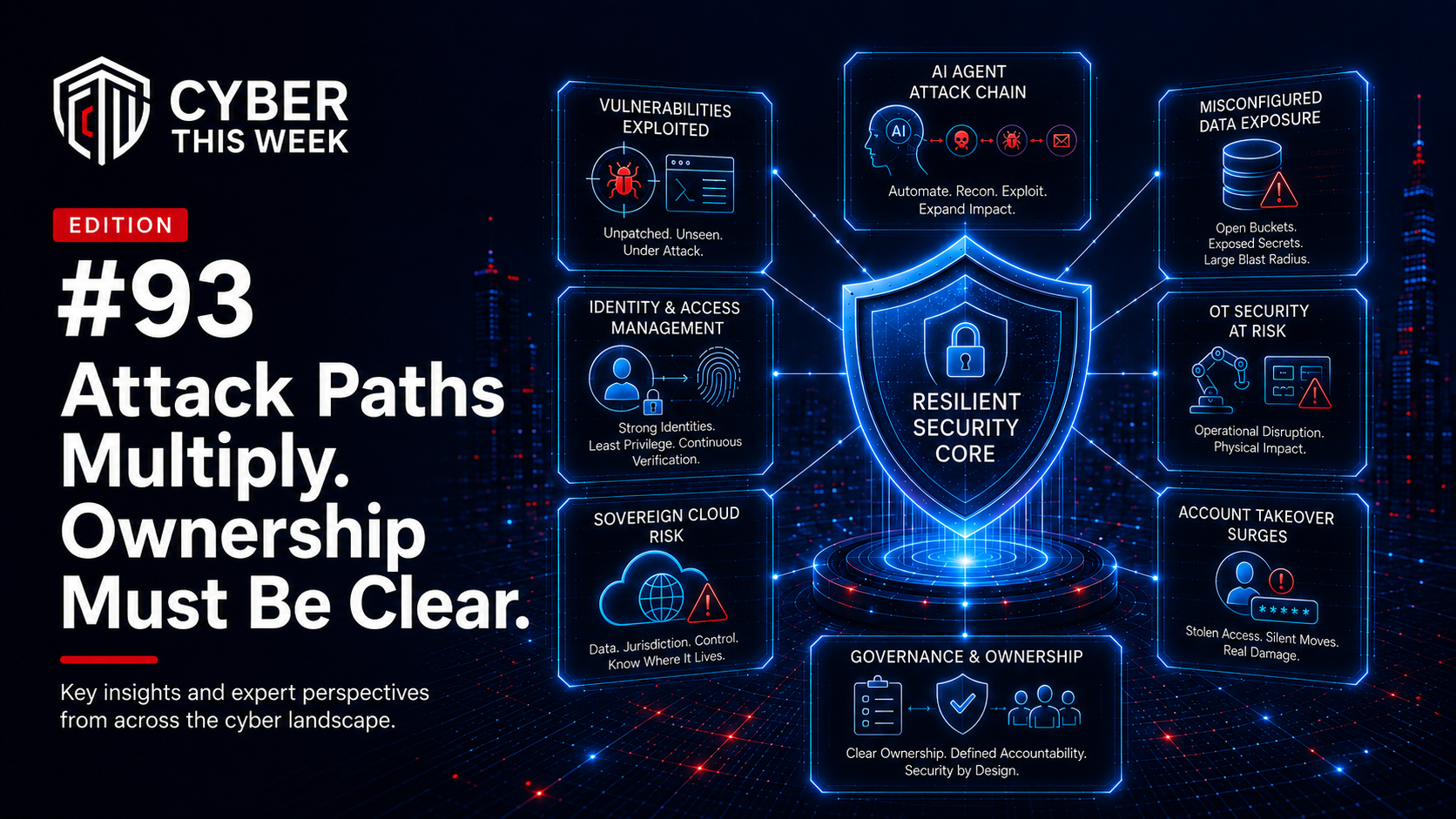
Attack Paths Multiply. Ownership Must Be Clear.
Cyber This Week Edition 93 explores vulnerability exploitation, AI-assisted attacks, cloud misconfiguration, industrialised cybercrime, AI governance, OT security, machine identities, account takeover, IAM platforms, and sovereign-cloud risk.
Cybersecurity is entering an era where scale is no longer the exclusive advantage of defenders. Attackers are leveraging AI, automation, and interconnected systems to move faster, adapt quicker, and exploit weaknesses that often remain hidden in plain sight. This edition of Cyber This Week explores how vulnerabilities, misconfigurations, identity gaps, and governance blind spots are becoming the preferred pathways into modern enterprises. From AI-assisted attack chains and industrialised cybercrime to the growing complexity of operational technology and sovereign-cloud security, the conversation is expanding beyond technical controls. The challenge now lies in ownership, accountability, and the ability to manage risks that cross organisational boundaries. In a world where not every risk has a contract, a perimeter, or a clear owner, resilience begins with visibility and informed leadership.
This Week's Articles
- 01CSO Online
Vulnerabilities Have Become Cyber Attackers’ No. 1 Door to the Enterprise
Vulnerability exploitation has overtaken credential abuse as the leading initial attack method in Verizon’s analysis of 31,000 security incidents. The article explains why traditional patch-management programmes must become faster, continuous, and risk-based.
Why it mattersAttackers are increasingly entering through known weaknesses. Organisations need continuous exposure management, faster remediation, and prioritisation based on actual exploitation risk.
- 02Sysdig
AI Agent at the Wheel: How an Attacker Used LLMs to Move From a CVE to an Internal Database in 4 Pivots
Sysdig observed an LLM agent carrying out real-time post-compromise actions after an attacker exploited a vulnerable internet-facing notebook. The attack progressed through cloud credentials and an SSH bastion to the theft of an internal PostgreSQL database in under an hour.
Why it mattersAI can help attackers move rapidly through complex environments. Security teams need stronger segmentation, credential protection, behavioural monitoring, and faster containment.
- 03SecurityInfoWatch
Exposed by Design: Why Misconfigured Data Stores Have Become Cybersecurity’s Silent Threat
Unsecured cloud databases and weak access controls are causing large-scale identity and data exposures without requiring sophisticated attacks. The article highlights misconfigured data stores as a dangerous but preventable enterprise risk.
Why it mattersMisconfiguration can expose sensitive data without malware or advanced exploitation. Strong cloud governance, secure defaults, and continuous configuration monitoring are essential.
- 04Fortune India
“AI Is Industrialising Cybercrime,” Says Google Threat Intelligence CTO
Generative AI is lowering the technical barriers for independent hackers, cybercriminal groups, and nation-state actors. Google Threat Intelligence warns that this is industrialising digital crime and intensifying the cybersecurity arms race.
Why it mattersAI enables more attackers to operate at greater speed and scale. Defensive programmes must prepare for higher attack volumes, improved social engineering, and faster adaptation.
- 05CPO Magazine
AI Risk Has an Ownership Problem, and Boards Are About to Discover It
AI adoption is advancing faster than many corporate-governance structures can accommodate. The article argues that organisations must clearly assign responsibility for AI risks, oversight, and decision-making before boards demand accountability.
Why it mattersUnclear ownership creates gaps in oversight and response. Boards need defined accountability for AI deployment, security, compliance, and operational consequences.
- 06InformationWeek
AI and Connected Systems Force CIOs, COOs to Rethink OT Security
Connected sensors, AI, and cloud analytics can improve operational efficiency, but they also create new cybersecurity and safety risks across physical infrastructure. Organisations must rethink visibility, incident response, and governance across converging IT and OT environments.
Why it mattersConnected operational environments combine cyber risk with physical and safety consequences. CIOs, COOs, and security leaders need shared visibility and accountability.
- 07Computer Weekly
When Your Biggest Security Risk Has Never Signed a Contract
Non-human AI agents are increasingly acting on behalf of organisations and gaining access to enterprise systems. The article examines the identity, authorisation, and accountability challenges created by securing autonomous entities that are not employees or traditional third parties.
Why it mattersAI agents may hold powerful access without fitting existing employee or vendor controls. Organisations need clear ownership, limited permissions, monitoring, and traceability.
- 08Security Magazine
From the Hammer to the Scalpel: The Evolution of Account Takeover
Account-takeover attacks have evolved from large-scale credential stuffing and brute-force attempts into targeted social-engineering operations. The article explains why behavioural analytics and continuous verification are increasingly important for identifying authorised fraud and sophisticated impersonation.
Why it mattersValid credentials no longer prove legitimate behaviour. Continuous verification and behavioural monitoring are needed to identify compromised or manipulated accounts.
- 09SC World
Key Questions to Ask When Evaluating an Identity and Access Management Vendor
Selecting an IAM platform is complicated by application integrations, directory requirements, and the need for custom development. The article outlines the questions organisations should ask vendors to uncover hidden complexity and determine whether a solution meets their operational needs.
Why it mattersIAM platforms affect security and daily operations across the enterprise. Careful vendor evaluation helps avoid integration problems, hidden costs, and control gaps.
- 10Cybersecurity Dive
How CISOs Can Manage Sovereign-Cloud Security Risks
Moving to regional or sovereign-cloud providers requires more than selecting a locally operated service. CISOs must perform detailed security and risk assessments covering data sovereignty, provider capabilities, regulatory obligations, and operational resilience.
Why it mattersData location alone does not guarantee security or compliance. Sovereign-cloud decisions require careful evaluation of providers, jurisdiction, resilience, and operational control.