
Cyber Risk Expands. Leadership Must Align.
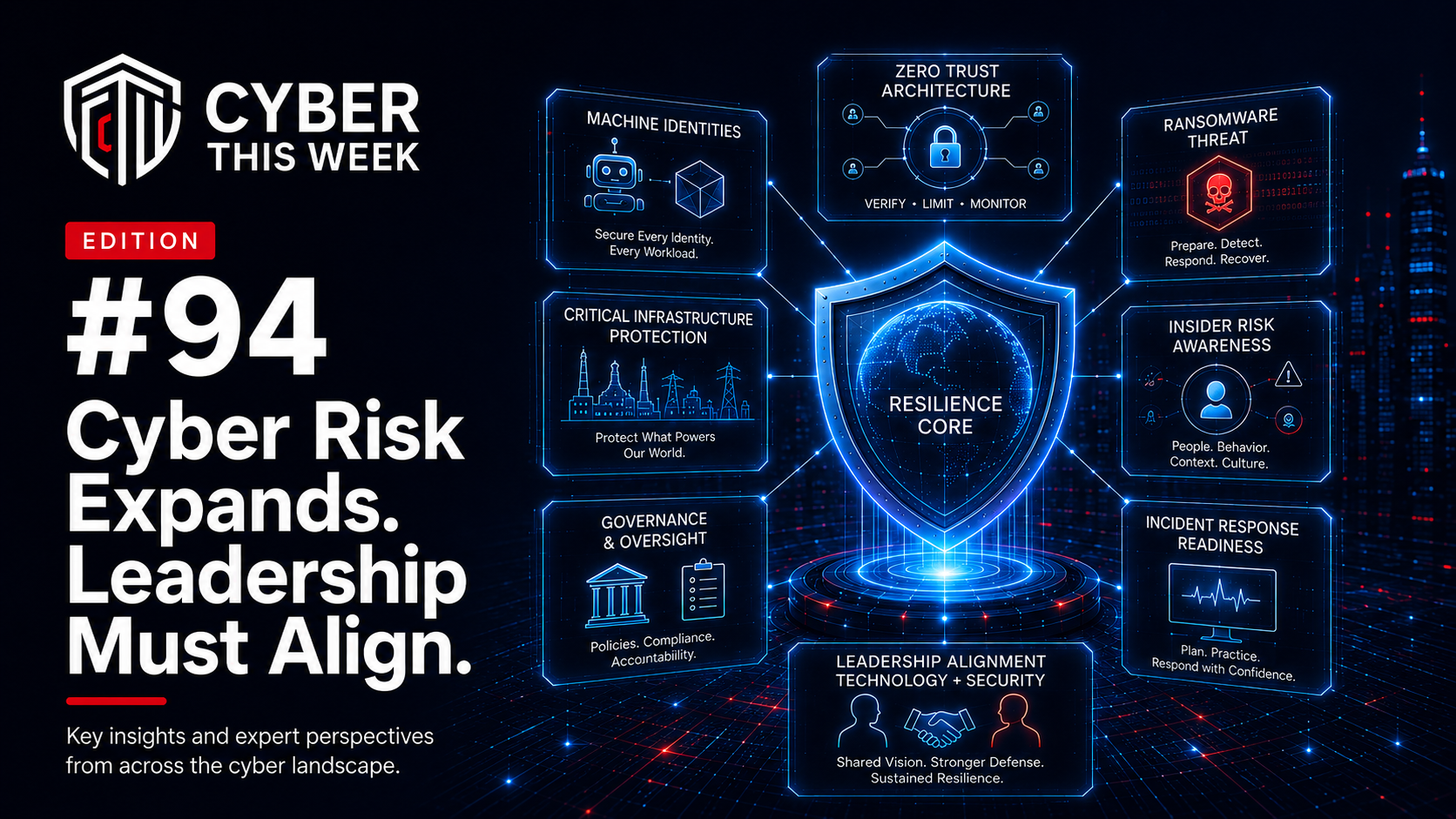
Cyber This Week Edition 94 explores cyber insurance, emerging threats, machine identities, zero trust, ransomware, critical infrastructure, industrial governance, insider risk, incident readiness, and CIO–CISO alignment.
Cybersecurity is steadily moving beyond the boundaries of technology and into the realm of leadership, governance, and organisational resilience. This edition of Cyber This Week explores a landscape where vulnerabilities are influencing insurance markets, ransomware continues to evolve, and industrial security is increasingly becoming a boardroom concern rather than an operational one. From machine identities and modern zero-trust principles to insider threats, incident-response readiness, and the growing need for alignment between CIOs and CISOs, a common theme emerges. Cyber risk is no longer confined to security teams. It is becoming a shared responsibility across leadership functions, critical infrastructure, and business strategy. As resilience begins to differentiate organisations competitively, preparedness is becoming as important as protection.
This Week's Articles
- 01Security Magazine
Schrödinger's Vulnerabilities: What Mythos Actually Broke in Cyber Insurance
The “Mythos” threat has exposed weaknesses in how cyber-insurance policies are underwritten. Static annual assessments and historical loss data are increasingly inadequate for measuring rapidly evolving cybersecurity risks.
Why it mattersCyber risk changes faster than traditional insurance assessments. Insurers and organisations need more continuous, evidence-based ways to evaluate exposure and control effectiveness.
- 02Dark Reading
4 Critical Threats Where Attackers Have the Advantage
Gartner analysts highlight four emerging threats where attackers currently possess a tactical advantage, including sophisticated deepfakes and large-language-model prompt-injection attacks. The article urges organisations to strengthen their defences against these rapidly developing techniques.
Why it mattersAttackers are adopting emerging techniques faster than many defensive programmes. Security leaders need earlier visibility, adaptive controls, and focused preparation for high-advantage threats.
- 03Forbes Technology Council
Managing Borderless and Machine Identities With Modernized Zero-Trust Principles
Modern organisations must move away from location-based perimeter security and adopt identity-focused zero-trust architectures. Strong identity visibility and control are required across cloud, edge, and on-premises environments.
Why it mattersUsers, workloads, and machine identities now operate across multiple environments. Zero trust must govern every identity and access request rather than relying on network location.
- 04SecurityInfoWatch
Ransomware Attacks Rise Slightly in May as Education Sector Sees Sharp Increase
Ransomware activity increased slightly during May 2026, largely because of a significant rise in attacks targeting educational institutions. Other industries experienced comparatively lower attack volumes than earlier in the year.
Why it mattersSector-specific increases can expose differences in preparedness, funding, and third-party dependence. Education organisations need stronger resilience and ransomware-response planning.
- 05Intelligent CISO
The Expanding Perimeter: Why CISOs Must Now Protect Critical Infrastructure
Cybersecurity has become a board-level issue as digital IT systems increasingly converge with physical and operational infrastructure. CISOs must broaden their responsibilities to address regulatory pressure and threats affecting critical systems.
Why it mattersIT disruption can increasingly affect physical operations, public services, and safety. CISOs need wider authority, operational visibility, and board support to manage converged risk.
- 06World Economic Forum
Why Industrial Cyber Risk Is Becoming a Governance Challenge
Growing connectivity is allowing cyber risk to spread across operational systems, suppliers, and public infrastructure. As a result, industrial cybersecurity is becoming an organisation-wide governance and resilience concern rather than only a technical issue.
Why it mattersIndustrial cyber incidents can affect operations, safety, supply chains, and communities. Accountability must extend beyond technical teams into enterprise governance and leadership.
- 07CSO Online
7 Tabletop Exercise Mistakes That Sabotage Incident Response
Poorly designed tabletop exercises can leave serious weaknesses in an organisation’s incident-response capabilities. The article identifies seven common planning and execution mistakes that prevent exercises from preparing teams for real cyber incidents.
Why it mattersExercises only improve readiness when scenarios, participants, decisions, and lessons are realistic. Weak tabletop design can create false confidence rather than resilience.
- 08Security Journal UK
How Risk Management Frameworks Protect Organisations From Insider Threats
Organisations can improve their protection against insider threats by incorporating sector-specific intelligence into their risk-management and awareness programmes. Employees should be trained to recognise and report behavioural indicators relevant to their particular industry.
Why it mattersInsider-risk indicators vary by role and sector. Contextual awareness, reporting culture, and risk-based controls can help organisations identify concerns earlier.
- 09Cybersecurity Dive
Turning Tension Into Collaboration: How CIOs and CISOs Can Lead Together
The traditional friction between IT and cybersecurity teams can become a source of organisational strength. Effective collaboration between CIOs and CISOs can align technology and security priorities while improving overall business resilience.
Why it mattersTechnology delivery and security cannot succeed through competing priorities. CIO–CISO alignment improves investment decisions, accountability, and resilience across the organisation.
- 10World Construction Network
Cyber Risk: Resilience Is Becoming a Competitive Advantage in Construction
As construction companies become more dependent on digital platforms and interconnected suppliers, cyber resilience is becoming commercially important. Strong governance and resilient systems can help firms protect project delivery and gain a competitive advantage.
Why it mattersCyber resilience increasingly affects delivery confidence, customer trust, and commercial performance. Strong security can differentiate organisations rather than functioning only as a defensive cost.