
AI Expands the Attack Surface. Trust Must Evolve.
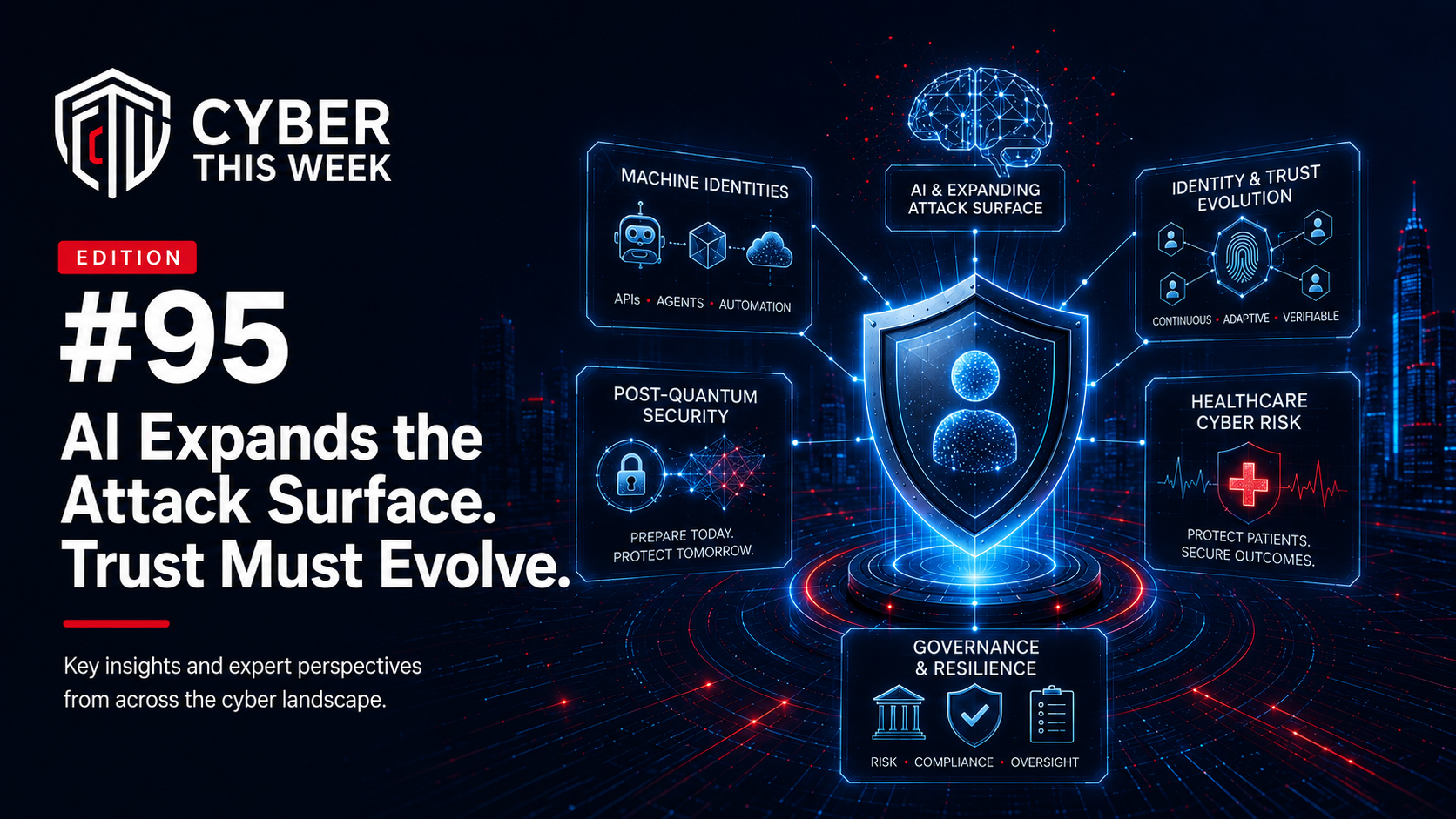
Cyber This Week Edition 95 explores frontier AI cyber risk, post-quantum encryption, machine identities, incident-response maturity, digital trust, AI governance, automated traffic, cyber roles, insurance, and healthcare security.
Artificial intelligence is no longer a future cybersecurity concern. It is rapidly becoming the defining variable shaping how organisations understand risk, trust, identity, and resilience. This edition of Cyber This Week examines a landscape where frontier AI models are offering glimpses into the next generation of cyber threats, while organisations struggle to keep pace with the expanding attack surface created by AI-driven systems and machine identities. From post-quantum encryption and healthcare cybersecurity to incident-response maturity and digital-trust erosion, a common thread emerges. The challenge is no longer simply adopting AI. It is understanding how AI changes assumptions that security programmes have relied upon for decades. As technological capability accelerates, leadership judgement and governance must evolve just as quickly.
This Week's Articles
- 01CSO Online
Frontier AI Models Offer Sneak Peak of Seismic Cyber Shifts Ahead
Frontier AI models could dramatically accelerate vulnerability discovery and exploit-chain identification. Security leaders should prioritise faster remediation, stronger identity controls, segmentation, and limiting the potential impact of breaches.
Why it mattersAI may significantly reduce the time required to discover and exploit weaknesses. Security programmes need faster remediation, stronger containment, and controls designed for machine-speed attacks.
- 02World Economic Forum
Why Post-Quantum Encryption Should Be Treated as Critical Infrastructure
Legacy digital infrastructure is increasingly exposed to AI-enabled and future quantum-computing threats. The article argues that quantum-safe encryption should be built into core network infrastructure rather than treated as an optional software upgrade.
Why it mattersPost-quantum migration will take years. Treating it as infrastructure planning helps organisations avoid future cryptographic exposure and rushed replacement programmes.
- 03Cybersecurity Dive
Companies Are Failing to Keep Up With AI’s Identity Sprawl, Creating Entry Points for Hackers
Organisations are rapidly creating accounts and machine identities for AI agents without adequate visibility or governance. These unmanaged identities can introduce excessive access privileges and new entry points for attackers.
Why it mattersAI systems are creating large numbers of non-human identities. Without clear ownership, access limits, monitoring, and rotation, these identities can become hidden attack paths.
- 04Cybersecurity Insiders
Three Incident Response Metrics That Actually Predict Program Maturity
Common measures such as mean time to respond and ticket volume may not accurately reflect incident-response readiness. The article recommends tracking escalation patterns, attacker dwell points, and the proportion of incidents detected by analysts.
Why it mattersResponse metrics should show whether a programme is improving its judgement and detection capability, not simply how quickly teams close tickets.
- 05SecurityInfoWatch
AI Is Turning Everyday Trust Into the Next Malware Battleground
Attackers are using AI to conceal malicious activity within trusted tools, familiar workflows, and convincing communications. Organisations must strengthen verification processes, awareness training, and technology-based defences against highly personalised attacks.
Why it mattersAttackers increasingly exploit familiarity and trust rather than obvious technical weaknesses. Verification must become stronger even when messages and tools appear legitimate.
- 06CPO Magazine
Inside Source Claims Anthropic Has Sent Mythos AI Engineers to NSA for Cyber Operations Training
The article reports claims that Anthropic engineers received cyber-operations training from the NSA. It examines whether the reported collaboration conflicts with Anthropic’s previously stated restrictions concerning autonomous weapons and domestic surveillance.
Why it mattersAI-security partnerships involving governments and model developers raise governance, transparency, ethics, and trust questions that extend beyond technical capability.
- 07Security Magazine
Organizations Think They Know Who’s Visiting Their Sites. They Don’t.
AI crawlers and automated scraping tools are generating increasing volumes of website traffic. Organisations that cannot distinguish legitimate visitors from automated agents may face performance problems, higher costs, and additional security risks.
Why it mattersAutomated traffic can affect availability, cost, data control, and security. Organisations need stronger visibility into non-human visitors and clearer policies for automated access.
- 08InformationWeek
How AI Is Changing the Breadth of Cybersecurity Roles
Artificial intelligence is expanding the responsibilities of cybersecurity professionals rather than simply automating existing work. Security teams increasingly need expertise in AI governance, model protection, data security, and AI-assisted threat detection.
Why it mattersCybersecurity roles must evolve with AI adoption. Organisations need new skills, clearer responsibilities, and training that combines security, data, governance, and AI expertise.
- 09Dark Reading
AI Risk Worries Insurers & Businesses Alike
Businesses and insurers remain uncertain about how to assess and cover risks created by artificial intelligence. Some insurers are developing specialised policies, while others are excluding AI-related operational losses because of limited historical data.
Why it mattersUnclear AI risk models may create coverage gaps and unexpected exclusions. Organisations need to understand how their insurance responds to AI-related failures and losses.
- 10Forbes
Why AI Is Creating New Cybersecurity Risks for Healthcare
Healthcare organisations face AI-enabled phishing and adaptive malware alongside risks targeting AI systems themselves. Potential threats include poisoned training data, manipulated diagnostic results, and attacks that expose sensitive patient information.
Why it mattersAI risk in healthcare can affect both privacy and patient outcomes. Security controls must protect data, models, clinical workflows, and the integrity of AI-supported decisions.